


Welcome to Threshold Conversations.
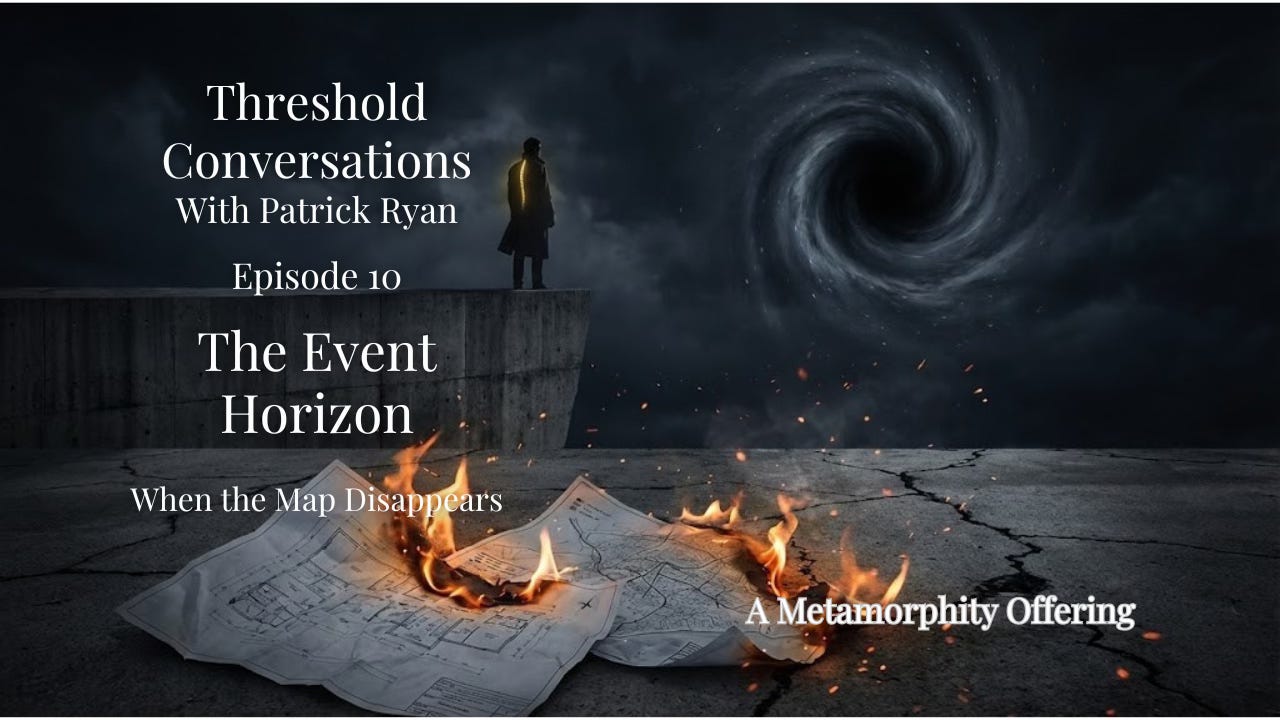
I’m Patrick Ryan and this is episode 10: The Event Horizon When the Map Disappears
This is a space for the architects of their own lives —
those standing at the edge of the known…
looking into the fog of what is becoming.
Recently, I had a conversation that stayed with me.
I was speaking with a professional —
highly intelligent… mid-career…
established in a medically related field
where artificial intelligence is already beginning
to rewire the very foundation of the work.
When I asked her how this shift was impacting her practice…
her response was immediate.
And visceral.
She said:
“I don’t want to think about it.”
It was a total shutdown.
A refusal to look at the weather.
As a coach, my entire career has been built on the opposite reflex —
seeking understanding…
future-dreaming…
talking through challenges
until the architecture of a solution emerges.
But her response made me wonder:
Which of us has the better strategy?
Is it better to be the Architect —
obsessively mapping the storm?
Or is there a hidden mercy
in being the Ostrich —
keeping your head down
until the dust settles?
Today, we’re going to explore
the internal physics of that “No.”
We’ll look at:
the Event Horizon of expertise,
the Distorted Pain of avoidance,
and how to find your skeletal integrity —
your ability to stay upright —
when the map you spent twenty years drawing
is suddenly erased by an algorithm.
⸻
Part One — The Anatomy of the “No”
When a high-capacity, intelligent person says
“I don’t want to think about it,”
they aren’t being lazy.
They’re experiencing a technical failure of their Scaffold.
For two decades, this professional leaned on a very specific
Back of the Chair —
a body of knowledge,
a set of credentials,
a predictable career path.
This was her architecture.
It provided safety.
It provided usefulness.
It provided a coherent identity
in the world of Ascholía —
the world of busyness and utility.
But AI represents a shift in the atmospheric pressure of reality.
It isn’t just a new tool.
It’s an Event Horizon —
a point beyond which the gravitational pull of change
is so strong
that even the light of our previous expertise
can’t escape.
When she looks toward that horizon,
her nervous system doesn’t register opportunity.
It registers collapse.
To “think about it”
would be to acknowledge that the floor is giving way…
that the roof is being torn off her life.
In the jet stream of 2026,
the velocity is so high
that looking directly at the change
can feel like a seizure of reality
the body simply isn’t prepared to metabolize.
So she chooses the Ostrich strategy.
This isn’t denial —
it’s Distorted Pain.
The story that says:
“If I don’t look at the storm,
the house will stay standing.”
But the physics don’t work that way.
The storm doesn’t care
whether your eyes are closed.
⸻
Part Two — The Architect’s Reflex
Now contrast this
with the Architect’s reflex.
I am someone who likes to talk about these things.
I seek understanding
as a way to navigate forward.
For the Architect,
conversation is how we build a new Scaffold in real time.
We believe that if we can name the monster,
we can manage it.
But we have to be honest.
Is the Architect’s strategy truly superior?
Or is it simply another way
of trying to stay in control?
In what I sometimes call
the Laboratory of Grief,
we learn there is a difference between
thinking about a problem
and standing inside a reality.
So I have to ask myself:
When I talk about the future…
am I actually finding the ground?
Or am I just building
a more sophisticated set of blueprints
to distract myself
from the fact that I, too,
am standing in the rain?
The Architect’s strategy is only better
if it leads somewhere real.
It’s only better
if the conversation isn’t just future-dreaming
to escape the present…
…but a technical investigation into
the skeletal integrity required
to remain upright
when the old labels of value are gone.
⸻
Part Three — The Event Horizon of Expertise
We are all approaching our own Event Horizon.
In medicine.
In law.
In coaching.
In creation.
The useful part of what we do
is being automated
at a rate our psychology was never designed to track.
AI is simply the most visible edge
of a larger truth:
Many of the maps we built our lives around
are dissolving at once.
If you identify as a Hammer,
and the world no longer needs nails
because the house is being 3-D printed by an AI…
your Why goes on strike.
This is the quiet ache
beneath that professional’s refusal to talk.
She isn’t afraid of the technology.
She’s afraid
of her own obsolescence.
The real work of this threshold
is a shift
from Ascholía — busyness and utility —
to Scholé — the pursuit of truth.
When the machine can do the useful work…
what is left for the human?
This is the moment most people rush past.
What remains is the Sovereign Spine.
The Unsupported Spine —
the part of you that doesn’t require
a career label
to stand.
The Architect’s strategy —
my strategy —
is to look at the AI horizon and ask:
“If I strip away everything the machine can do…
what is the one inch of me
that remains untouched?”
That question
opens the muse’s vigil.
It creates space
for possibility to emerge.
⸻
Part Four — Setting Up the Laboratory
So how do we navigate this?
Whether you feel like the Ostrich today
or the Architect…
the physics remain the same.
You cannot coach yourself out of a storm.
You can only
find your floor.
I want to invite you into a Micro-Solo —
a small dance with emergent possibility.
Set up a Temenos Window.
Thirty minutes
of intentionally useless time.
First — Separation.
Leave the device.
Leave the jet stream of notifications
telling you what you should think about AI.
Second — Liminality.
Sit in the boredom.
Feel the Manager in you panic
because you’re not being useful…
or productive.
Third — Inquiry.
Don’t ask how to fix your career.
Ask a threshold question:
“If my expertise was a map that is now burning…
what is the ground
I am standing on right now
that doesn’t require a map?”
⸻
Conclusion — Standing Watch
The better strategy
isn’t to look away.
And it isn’t to talk
until you’re exhausted.
The better strategy
is to notice.
The Ostrich is trying to protect her peace —
but she’s losing her agency.
The Architect is trying to maintain his agency —
but he risks losing his peace
to the noise of the future.
The middle path —
what I call the Metamorphity path —
is the Vigil of Musing.
It is standing at the threshold
with an unsupported spine
and saying:
“The weather is changing.
The map is gone.
But I am still here.
And my imagination
is still the source
of my reality…
and my creativity.”
Don’t wait for misfortune
to force you to look.
Choose to stand watch
for emergence
today.
Thank you for listening to Threshold Conversations.
If you found yourself in the Ostrich…
or the Architect today…
I invite you to share that data
in the comments on Substack.
Let’s build the floor together.
Until next time —
step into the threshold.
And don’t be afraid
to look at the rain.


