

Welcome to Threshold Conversations. I’m Patrick Ryan. This is Episode 21: The System of Us.
There is a particular feeling I know well from thirty years of facilitation work. It arrives before the group does. Before anyone has spoken, before the circle has formed, before the first instruction has been given.
It is the feeling of knowing what is possible — and knowing it is not a certainty.
I have stood at the front of many rooms carrying that feeling. Carrying the knowledge of what can happen when twenty people genuinely open to something larger than themselves. Carrying the trust that the conditions are right, that the group has what it needs, that the water is there if they are willing to drink.
And here is the thing about that water: not one of them came asking for it. Because unless you have experienced it, you wouldn’t know what to ask for.
That is the particular burden and privilege of the facilitator. To bring people to a sacred well. To know that it is the water that will do the work, not you. And to stand there in the uncertainty — holding the field, offering the guidance, taking a stand for a destination no one else in the room can yet see.
This episode is about what happens at that well. And about what it means for the age we are living in.
The exercise is simple in its structure and demanding in its execution.
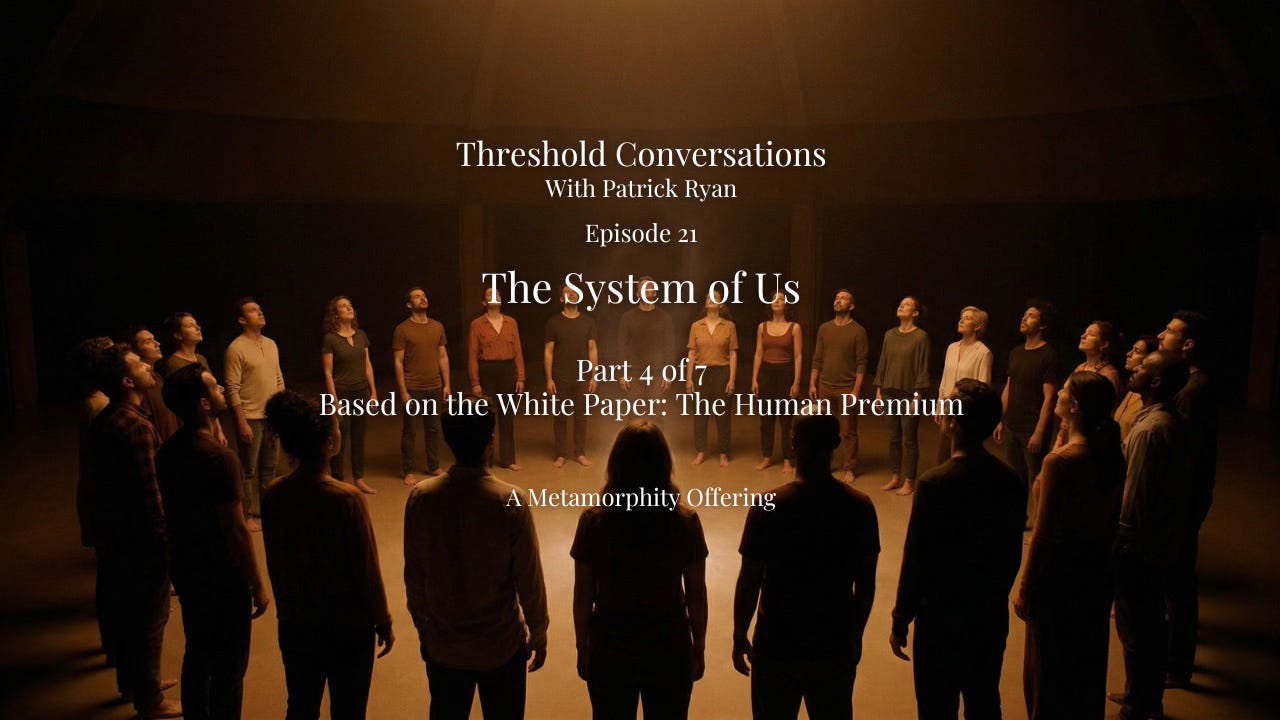
I would invite a group — usually around twenty people — to form a standing circle. Then I would ask each person to begin making a sound. Their own sound. Whatever wanted to come out of them in that moment. The instruction was clear: don’t perform, don’t harmonize deliberately, don’t listen for what the group might want. Just find your own sound and commit to it fully.
The result, every time, was cacophony. Twenty distinct voices going their own way. No agreement, no pattern, just the raw plurality of twenty different people expressing something unrehearsed.
Then the second instruction: keep sounding, but now bring your attention from inside yourself to the centre of the circle. Stay with your own sound — don’t abandon it — but hold it more lightly. Let finding the group sound become more important than defending your own, without disappearing into the group entirely.
And then the coaching began.
Softer. Louder. Let go of your idea. Bring your heart out to the room. Become willing to blend. Be flexible.
The group would begin to hunt. The collective sound moving in waves — reaching toward something, almost finding it, settling back, gathering itself, reaching again. Each wave a collective attempt. Each quiet moment a kind of recalibration.
I have done this exercise dozens of times. And the groups that moved me most were not the ones that found the note easily.
They were the ones that almost didn’t.
Sometimes the room carried weight before anyone made a sound.
History. Conflict between personalities. Old grievances that had never quite resolved. People who had spent months or years in the same organization and had arrived in that circle carrying the accumulated residue of every difficult meeting, every misaligned decision, every moment when trust had been asked for and not quite delivered.
In those rooms the cacophony was different. It wasn’t just twenty people going their own way. It was twenty people going their own way while also protecting themselves. The dominant voices pushing harder. The wounded voices pulling back. People who wanted the group to find them rather than them finding the group.
The coaching had to go deeper in those rooms.
Let go of your attachment. Not to your sound — to being right about your sound. Let go of needing the group to come to you. Open to what this group actually needs, not what you think it needs.
And then something would happen that I never tired of witnessing.
The people with the most invested in their own position — the ones who had been pushing hardest, protecting most, needing most to be heard on their own terms — would let go.
Not all at once. One by one. You could see it before you could hear it — a softening around the eyes, a release in the shoulders, a quality of listening that hadn’t been there a moment before. And as each one arrived at that surrender, the collective sound shifted. The hunting became less effortful. The waves came closer together.
And then, at a moment that could not be predicted or forced, it locked.
Every voice found the same tone simultaneously. Not because anyone had decided on it. Not because I had directed it. Because the group had learned its way there together — each person holding their own thread while remaining genuinely open to something larger than themselves.
The hair on your arms stood up. The room resonated as if the space itself had become an instrument. Hearts opened. Something that can only be called jubilation moved through the circle.
And then — without anyone calling for it, without any instruction from me — the sound came to its own crescendo and fell into silence.
Twenty people standing together in a circle. The silence holding everything that had just happened. The weight of the history that had been in that room an hour ago somehow transformed — not erased, not resolved, but no longer the largest thing present.
How long did the silence last? Ten seconds, perhaps, on the clock.
How long is infinity?
Then the cheer came. Spontaneous, unrehearsed, from somewhere below the chest. Celebration that didn’t need to explain itself because everyone in the room had felt the same thing simultaneously and knew it.
That is the System of Us. Not as a concept. As a felt reality.
And what I want to sit with — what I think this moment points toward that the white paper, The Human Premium, can only gesture at — is this: what became possible in that room was not achievable by any one person in it. Not by the most talented. Not by the most senior. Not by the most spiritually advanced. It required the full plurality of everyone present. Including — especially — the ones who had been most resistant.
The dominant voice that finally let go was not peripheral to what happened. It was essential. The group could not have found that note without them. Their surrender was the last piece the whole required.
The full range of what humanity actually is cannot be heard in the narrow frequency the economy has ever valued. It requires the whole instrument.
Think of what was in that circle. Not just twenty voices. Twenty completely different relationships to sound, to group, to surrender, to history.
Twenty different wounds and gifts arriving at the same note simultaneously. None of them interchangeable. None of them dispensable. The person who held out longest — who had the most history, the most armor, the most reason not to open — was not the obstacle. They were carrying the frequency the group needed most. Without their surrender the note would have been incomplete.
That is the System of Us.
Not a collection of compatible people. The full plurality of human expression — every temperament, every tradition, every form of aliveness — organized not by economic necessity but by the impulse toward genuine contribution.
When survival pressures lift, when the question of whether there is enough begins to resolve, something remarkable tends to happen. Each person moves toward what lights them up rather than what keeps them safe. And the whole begins to sound like itself.
Artificial intelligence may be creating the conditions for that movement to become universal rather than reserved for the few. But only if we remain awake to what the system actually requires from us.
Now let me name what this has to do with artificial intelligence. Because it is not obvious and it is not what you might expect.
The argument is not that AI cannot generate the appearance of group coherence. It can simulate the conditions. It can optimise for alignment. It can identify the patterns that typically precede collective breakthroughs and nudge groups toward them.
But AI cannot want the note.
It cannot take a stand for something it cannot yet hear. It cannot hold the field in the uncertainty between the cacophony and the lock, knowing what is possible and trusting the group to find it. It cannot feel the hair rise on its arms when twenty voices arrive at the same tone simultaneously.
And here is the deeper risk — the one I think about most.
As AI takes on more and more of the cognitive and analytical work of civilization, there is a specific and quiet temptation: to let it lead. Not in one dramatic decision, but degree by degree. The machine is faster. The machine is more comprehensive. The machine never tires and never carries the weight of uncertainty the way a human facilitator does standing at the front of a difficult room.
It becomes easier, almost imperceptibly, to defer. To let the machine identify the next step, frame the next question, direct the next conversation. And each deferral is small enough to feel harmless.
But what is lost in that deferral is not efficiency. It is the human willingness to take a stand for something not yet visible. To hold a field for a possibility the group cannot yet imagine. To bring people to the well knowing it is the water that will do the work.
That is not a function. It is a form of presence. And it cannot be outsourced without cost.
For this week — one invitation.
Think of a group you are part of. A team, a family, a community — any constellation of people with shared purpose and genuine differences.
Before your next gathering — even an ordinary one — notice what sound you’re planning to make. What position you’re arriving with. What outcome you’ve already decided you need.
And then ask yourself the question I used to offer into those circles when the group was close but not yet there:
What does this group actually need from me right now — and is that the same as what I came in wanting to give?
You don’t have to abandon your note. But hold it more lightly. Bring your attention from inside yourself to the centre of the room. Stay with what you have to offer — but let finding the group sound become more important than defending your own.
Notice what shifts. In the room. And in you.
Next week we move from the collective to the civilisational. From what becomes possible when people genuinely open to the three futures humanity is already choosing between — not as abstract possibilities but as lived environments.
The texture of your day. How you feel in your own mind when you wake up inside each one.
And the honest question of what makes the easier futures so genuinely seductive — because unless we name the seduction clearly, the warning means nothing.
Episode 22 is called The Three Futures.
Thank you for listening to Threshold Conversations. Until next time… keep your spine unsupported. And keep walking toward the light.


