

Welcome to Threshold Conversations. I’m Patrick Ryan.
This is the first of five episodes — a sustained inquiry into what could be real or not about this world we inhabit, and how I came to my current understanding.
The arc opens here and closes in Episode 29. The threshold remains open.
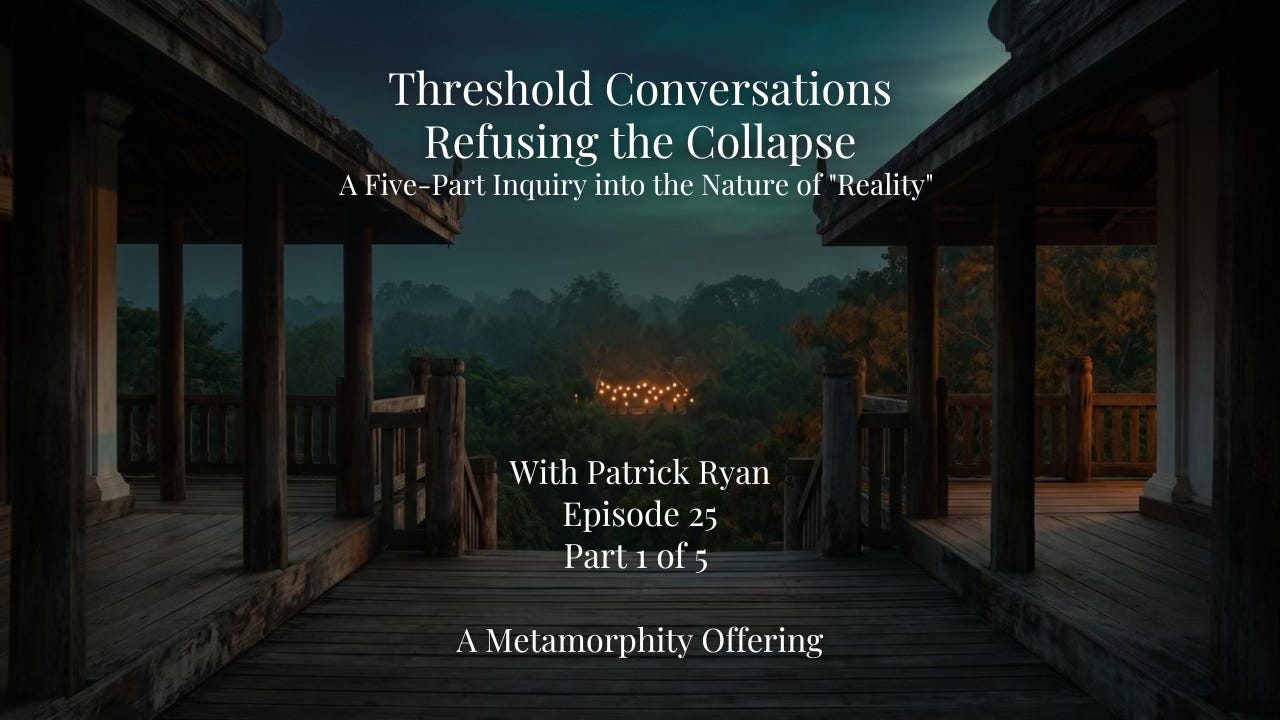
I want to take you back about thirty years. To a wooden bridge outside a monastery in Rangoon.
It was night. I was a Buddhist monk at the time, ordained earlier that year. I had just finished evening meditation in the monastery’s main hall — the long chants in Pali still resonating in my body, the kind that don’t stop when the words stop. I stepped outside onto the second-floor walkway and into the dark.
From there I had a long view across the surrounding treetops into the city. I could see no one. But off in the distance, through the thick trees, a yard was lit up with hundreds of small white lights. Something about them looked mystical at that distance. And from the same direction, drifting up through the steamy night air, I heard the sound of the blues.
Not faintly. Clearly. The melancholy of it tugging at my heart. A guitar, a voice, the slow sad hang of the notes — drifting through air that just minutes before had been holding ancient chants.
I stood on that bridge between two buildings and could not quite reconcile what I was experiencing. The chants had taken me somewhere I do not have words for. The blues were tugging at something just as deep — but a different kind of deep. Something more grounded, more human-scaled, more about the specific ache of a specific life.
I noticed something in myself wanting to figure out which one was more real. Which one was the deeper truth. Which one I was supposed to be choosing.
And I noticed, just as quickly, that the question itself was wrong.
Both were completely alive. Two simultaneous truths within one reality. The chants and the blues were not competing for first place in some hierarchy of authenticity. They were both happening. They were both true. They were not the same — and they did not need to be ranked.
I stood on that bridge for a long time.
That moment has stayed with me for thirty years.
I want to tell you why I keep coming back to it. And I want to tell you what these five episodes are going to walk through together, so you know what you are signing up for.
What I noticed on that bridge — and what I have noticed over and over since — is that we live in a culture that is always trying to figure out which version of reality is the real one and what caused this universe in which we live. Some say God, some say materialism, others suggest that we are living in a simulation and there are many more attempts to explain. bottom line, no one knows which level of explanation is the truest. Which thing underneath this thing is what is really going on. I am inviting you to use this arc of 5 episodes to be a thought partner for you. This could be fun, let’s go!
We are taught to look past what is happening right in front of us, and to look for something more fundamental somewhere else. The chemistry beneath the experience. The code beneath the rendering. The plan beneath the day. The real reality somewhere behind the one we are actually living.
I have spent thirty years quietly suspicious of that move.
What I want to walk through with you across these five episodes is what becomes possible if we stop making that move. If we let what is here be what is here. If we stop reaching past the present moment for something more fundamental that is supposedly running it from somewhere we cannot see.
That is the inquiry. Five episodes. Conversations more than arguments. I will tell you stories from my life that have shaped how I think about this, and we will see together what they open up.
Before we go on, I want to say where I am standing.
I have spent thirty years inside traditions — Buddhist, shamanic, indigenous, contemplative — that take a particular view of what is going on here. The view is this. Reality is not being run from somewhere else. Your experience right now is not a side effect of something more fundamental happening underneath. What is happening, here, in your life as you are living it, is the actual thing. Not a copy of the real thing. Not an output of the real thing. The real thing itself.
I think of it like music.
A song when played live is not stored somewhere waiting to be played. The song is what is happening when someone plays it. The notes in the air, the voice in the room, the breath of the singer — that is the song. There is no song hiding backstage that the performance is a copy of. The performance is the song.
I have come to think that life is like that. Your experience right now is not a copy of something more real happening somewhere else. It is the actual thing, occurring as itself.
You do not have to believe what I just said. The walk we are going to take across these five episodes does not depend on you agreeing with me. It depends only on your willingness to suspend the rush to look past what is here. To stay, for a while, with what is actually present, and see what becomes possible.
Here is what we are going to do, then.
We are going to refuse one specific move. The move of treating your present moment of conscious experience as a side effect of something more fundamental happening somewhere you cannot see. The neurons beneath the experience. The substrate behind the rendering. The plan written before you arrived.
These are all versions of the same gesture. Look past what is happening. Find the real cause somewhere else. Treat what you are actually living as a kind of by-product of the real action that is taking place backstage.
That is the move I refused on the bridge in Rangoon. The chants were sounding. The blues were sounding. Neither was a by-product of something more fundamental somewhere else playing them out. The reaching for a hierarchy was the gesture that would have falsified the moment, and I knew it.
You do not have to share my view to walk this with me. Anyone willing to set aside the rush to flatten what is actually present, in favour of something more fundamental somewhere else, can take this walk.
I want to spend a minute on one specific version of this move that is everywhere right now. The simulation hypothesis.
The idea that we are probably living inside a computer simulation has gained extraordinary traction in tech and entertainment circles over the past decade. It shows up in podcasts and dinner conversations as if it were settled. We’re probably not in base reality. Said with the confidence of someone who has done the math.
I am not arguing that simulation theory is wrong. I genuinely do not know.
What I am saying is that the popularity of this hypothesis right now reveals something. It reveals a cultural impatience. The hunger for a single answer about what is really doing the work in this world. The desire to relocate the real action to somewhere we cannot see, so that the strangeness of the present moment becomes comprehensible by being explained from elsewhere.
In an earlier century, the same impulse located the real action beneath religious cosmology. In the last century, it located the real action beneath fundamental particles. In ours, increasingly, it locates the real action beneath computational substrate. The flavour changes. The move underneath stays the same.
The collapse is comforting precisely because it removes mystery. And in a moment when the world is increasingly disorienting, removal of mystery feels like clarity.
What feels like clarity is actually closure. Closure is a collapsed condition disguised as clarity. Convenient for those who want to land the idea and move on. But this convenience comes with a price.
What I learned standing on that bridge in Rangoon was not a position to defend. It was a posture. A way of standing in life.
The chants did not need the blues to be permitted. The blues did not need the chants to validate them. Both were happening. Both were alive. The mind could keep reaching for a hierarchy, and the bridge would keep refusing to provide one. Eventually the reaching softened. What was left was simply what was there.
Years later, after I left the monkhood and walked through the Himalayas and eventually came home and built a coaching practice and wrote a white paper about presence — I have come to suspect that this posture is not a small thing.
It is the practice that makes everything else possible.
The Human Premium series argued that presence, coherence, and beauty are humanity’s irreducible contribution. It made that case across seven episodes through stories from coaching rooms and prison yards and circles and electrical cabinets. What it did not fully say — what these next four episodes are going to walk toward — is why. Why these capacities are irreducible. Why what passes between two human beings in genuine contact is doing something genuinely fundamental, and is not a side effect of something more fundamental happening somewhere else.
The why begins on a bridge. The why begins with refusing the collapse. The why begins with the recognition that your present moment of conscious experience is not a stand-in for something more real. It is fully here, fully alive, fully participating in whatever this is — and does not need a more fundamental layer beneath it to make it count.
For this week, one invitation.
The next time you encounter a confident claim about the nature of reality — whether from a podcast, a tech entrepreneur, a scientist, a spiritual teacher, anyone — notice whether the claim is performing a collapse. Notice whether it is asking you to flatten what is actually present in your experience into something more fundamental that you are supposed to take on faith.
You don’t have to argue with the claim. You don’t have to refute it. Just notice the move. And ask yourself, quietly, whether you are willing to invoke it.
You may decide you are. That is a legitimate choice.
But if you find yourself, like me, not quite ready — if you find that the bridge between multiple simultaneous truths feels more honest than the relocation of the music to a score elsewhere — then you are standing where this arc begins.
We are going to spend the next four episodes walking that ground. Not arguing for any final answer. Walking what becomes possible when you refuse to flatten what is actually here.
Next week starts with a moment on a forest path in Burma, when a woman from the Karen State began to dance by firelight, and something I had been carrying my whole life dissolved.
The episode is called No Elsewhere.
Thank you for listening to Threshold Conversations. Until next time… keep your spine unsupported. And keep walking toward the light.


