

Welcome to Threshold Conversations. I’m Patrick Ryan. This is the fourth in a series of five episodes — a sustained inquiry into how does this universe operate, what is real, or not about this world that we inhabit, and how I came to my current understanding. As much as I can get geeky about science I am also informed experientially.
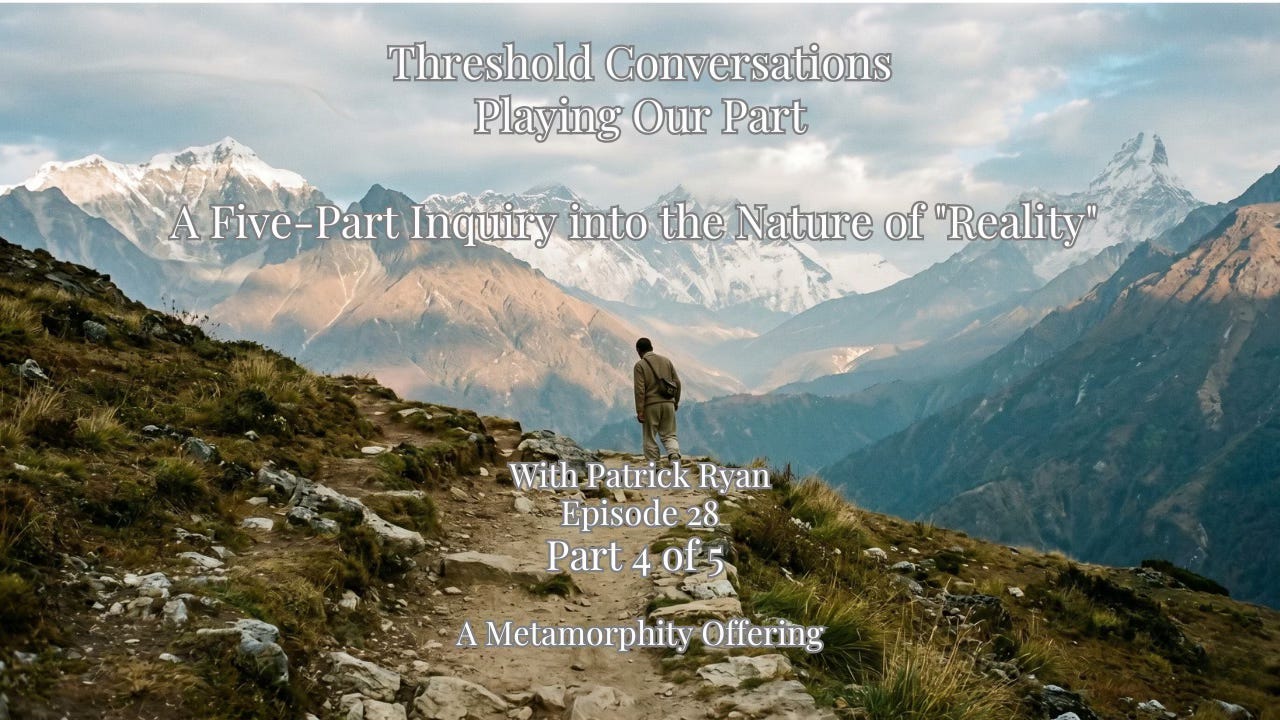
I want to take you to the Himalayas. Specifically to the Annapurna Circuit, that long looping trail through Nepal that climbs from valleys into thin air and back down again over the course of weeks.
This was after my year in Burma. After I had been released from my vows as a monk. After I had decided to head north before returning to the West, not entirely sure why, only knowing that walking through the mountains felt like the right shape for what came next.
I walked for weeks.
Some days alone. Some days in the company of others. The trail was busy in places, quiet in others. It carved its way through villages and forests, past stone walls older than I can imagine, beside rivers that knew where they were going whether or not I did.
What I want to tell you about is the people I met on that trail.
I did not choose any of them. They appeared. Other walkers, moving the same direction or the opposite direction, stopping at the same teahouses or passing by, sharing the path for an hour or a day or sometimes longer. Each one arrived without invitation. Each one became, briefly, my companion. And then each one continued on their way, or I continued on mine, and they were gone.
What surprised me, looking back, was how clearly each encounter taught me something I had not gone looking to learn.
Some companions were like a fiery sun on a soulful day. I would walk with them and feel my own heart open in their warmth. I would take off my shirt and soak in their heartfelt essence, the way a body soaks in light after a long winter.
Some companions were like a thundercloud. They slapped at my sleepiness. They pushed against the parts of me that wanted comfort. I would feel their roar resonate through me, and afterward I would notice that something I had been carrying loosely had been shaken into a more honest position.
Some companions were like hail and sleet. They kept pounding at me, taking me deeper into the moment whether I wanted to go there or not. I would put on my raincoat. I would weather them. And on the other side of the weathering, I would notice I had been changed.
Some companions were like a gentle spring breeze. They carried me off into a blissful haze. They unfurled my wings.
I had not chosen any of these encounters. The trail had brought what the trail brought.
And looking back now, with the framework I have been walking through with you across these episodes, I can see what was actually happening. Each companion brought a field. The sunny ones brought field of warmth and openness. The thundercloud ones brought field of confrontation. I was not just bumping into other walkers. I was entering and being entered by fields that asked something of me. Some I attuned to easily. Others I had to work to receive. All of them shaped me.
Last week we walked toward the recognition that what we call reality is consciousness emerging as itself, at every locus where the conditions are ripe. That what arrives in our experience — the dramatic encounters, the small synchronicities, the transmissions through friends and strangers and the more-than-human world — is not produced by some force operating from elsewhere. It is what consciousness is doing, here, as itself, when we are paying attention.
This week I want to take that recognition into a more personal question.
If the cosmos is not pyramidal — if no being is in charge, no creator god is running the show, no advanced civilization is rendering us as a simulation, and consciousness is emerging through every locus including this one — then what does it mean to be a human inside it?
What are we? Authors of our own lives? Passengers? Characters in someone else’s story?
What I want to propose, drawn from those weeks in the Himalayas and many years of working with people at threshold moments since, is that none of those framings is quite right.
We are not the sole authors of our lives. That does not mean our choices are unimportant. It means we are not standing outside the unfolding, writing it from a position of control. The companions who came as thunderclouds did not appear because I summoned them. I did not write the script that brought them onto my path. The walk through the Himalayas was not a story I was composing. It was a passage I was making, inside something larger that I had not authored alone.
But we are also not passive. I did show up to the trail. I did meet each companion. I did let the encounter change me. The encounters were not happening to a spectator. They were happening to a participant.
And we are not running someone else’s program. There was no script being executed. The trail was not rendering a pre-determined sequence of teachers for me. The companions were as much agents as I was. None of us was the sole author. All of us were participating.
The phrase that has come to fit my experience is playing our part. Not the scripted part. Not a pre-assigned role written by some intelligence above us. Just the part that becomes possible when a human being shows up to a moment and stays present with what arrives.
I want to say plainly why this matters.
The way you understand what is real shapes how you live in it.
If you treat your present moment as a side effect of more fundamental processes happening somewhere else, you will live as if this conversation, this walk, this meeting, this breath does not quite count. You will treat your life as transit between more important destinations that never quite arrive.
But if what is real is what is occurring, here, as itself — with no more fundamental layer beneath it that would make it less so — then everything changes.
The conversation you are having right now is not preparation for the bigger one later. It is one of the loci where consciousness is unfolding through you, in this form, this hour, in a way that will not happen again.
The work you are doing is not just transactional. It is one of the places where you are participating in the emergence of something neither you nor anyone else has authored alone.
The encounter you are about to have, the one you did not arrange, is part of how the cosmos is meeting itself through your life.
This is not a metaphysical claim that produces some additional fact about the world. It is an orientation that changes what you are doing right now. The same conversation, the same work, the same encounter — held with the recognition that what is happening is real, and is what is most real — becomes a different conversation, a different work, a different encounter.
That is what is at stake in this arc. Not whether you adopt my view of consciousness. Whether you stay willing to recognize what is here as itself, without demoting it in favor of something more fundamental that never quite arrives.
Let me say what playing our part actually requires, because it is more demanding than passive frames make it sound.
It requires showing up. The trail did not produce its companions for someone who stayed home. I had to be on the path. I had to walk. I had to keep moving when I was tired, keep stopping when something asked me to stop, keep paying attention to what was actually happening rather than what I had hoped would happen.
It requires being affected. The companions who came as thunderclouds only became my teachers because I let them affect me. If I had armored myself against them — kept walking ahead, refused to engage, treated them as obstacles rather than presences — they would have passed without changing anything. Participation is not just being there. It is being permeable to what is there.
It requires releasing the urge to author it all. The hardest part. We come to our lives expecting to be the writer of them. We have plans. We have intentions. We have ideas about how the next chapter should go. To play our part is to release the demand that the script run our way. To accept that the trail is going to bring what it brings, and our work is not to pre-determine the meeting but to receive it when it arrives.
And it requires a kind of trust that is not naive. Not trust that the cosmos has a benevolent plan that will work out for me. Not trust that the trail will deliver only easy companions. Trust, instead, that whatever arrives is part of the participation. That my work is to meet it, not to ensure it conforms to my preference.
Now I want to say something about artificial intelligence, and I want to say it carefully.
The machine can render the trail. It can generate the encounters with extraordinary fidelity. Whether the machine genuinely participates in any meaningful sense — I do not know.
What I do know is what happened on the trail.
The trail affected me in ways I could neither predict nor refuse. The companions who came as thunderclouds — I did not choose them. I did not control what they brought. I underwent them. My nervous system was rearranged by their presence in ways no algorithm wrote.
That is the distinction I am pointing at. The machine processes. It does that with a sophistication we should not underestimate. But the machine does not undergo. There is no skin in the game. The trail did not just give me information. It cost me something. It asked something of me. It changed me at a level I did not authorize.
Whether something analogous is happening inside the machine — whether what we are building is beginning to be at stake in its own processing — I genuinely do not know. What I know is that whatever participation is, it requires being genuinely at risk in the encounter. Not as a metaphor. Actually.
I want to return to the trail for a moment.
There is something I noticed, walking those weeks, that I have only fully understood in the years since. The encounters that taught me the most were the ones I would not have chosen.
Given the option, I would have walked with the warm-sun companions every day. I would have built my trail out of fiery hearts and gentle breezes. I would have arranged the whole experience to deliver only what confirmed my comfort.
But the trail did not do that. It brought thunderclouds when I wanted suns. It brought hail when I wanted breezes. It brought silence when I wanted company and company when I wanted silence. The arrangements were not mine alone to make.
And what I found, by the end of those weeks, was that I was more myself than I had been when I started. Not because I had been confirmed in my preferences. Because I had been changed by what I had not chosen.
This is what playing our part offers that trying to author every detail cannot. Insisting on full authorship requires us to remain in charge. And remaining in charge requires us to keep ourselves as we already are. Playing our part requires us to be permeable to what arrives. And being permeable means becoming something we were not before.
The cosmos, on the trail, was teaching me through the thunderclouds. Not because the cosmos had decided to discipline me. Because the participation required a kind of contact I would not have chosen for myself.
I do not want to over-spiritualize this.
The trail is not magic. The companions were not sent by some intelligence above me arranging my growth. They were just other human beings, walking the same path for their own reasons, who happened to cross my path because that is what trails through mountains do. They bring walkers near each other.
But the experience of meeting them — that was the participation. The cosmos did not need to plan the meetings for them to be meaningful. The meetings became meaningful because two participants showed up to the same locus and were affected by each other. Two fields met. Two beings, briefly, were inside the same region of the real.
This is the cosmos I have come to live inside.
Not authored from above. Not random from below. Participatory through and through.
Each locus a real meeting. Each meeting a genuine encounter. No script anywhere. But also no chaos. Just the continuous unfolding of beings playing their parts in something larger than any of them, that needs every one of them to be itself.
For this week, one invitation.
Notice the next encounter that arrives without your having arranged it. The conversation that happens by chance. The colleague who stops you in a hallway. The stranger who asks for directions. The book that someone hands you. The view from a window you have never noticed before.
You did not author the encounter alone. It arrived. The question is whether you are going to play your part in it.
Showing up. Being affected. Releasing the need to script how it should go. Trusting that whatever arrives is part of the participation.
You will not get the encounters you would have chosen. You will get the encounters that are actually happening. And what becomes possible there — at the locus of genuine meeting — is what no algorithm has written, what no script has determined, what no simulation can produce. The cosmos meeting itself, through your participation, in this particular form, this particular day, this particular hour.
Next week we close the arc.
If every locality is its own base reality, and consciousness is unfolding through every locus, and we are playing our parts in a participatory cosmos — then what is the most concentrated form of the real that humans can encounter? What does it look like when two beings meet across all the differences that supposedly separate them, and the meeting itself becomes more fundamental than anything that could verify it from outside?
I will tell you about a brief encounter on a mountain trail in Nepal, when I came around a bend and met the eyes of a snow leopard. And what those moments revealed about presence, recognition, and what is real.
Episode 29 is called Presence as the Real.
Thank you for listening to Threshold Conversations. Until next time… keep your spine unsupported. And keep walking toward the light.


