

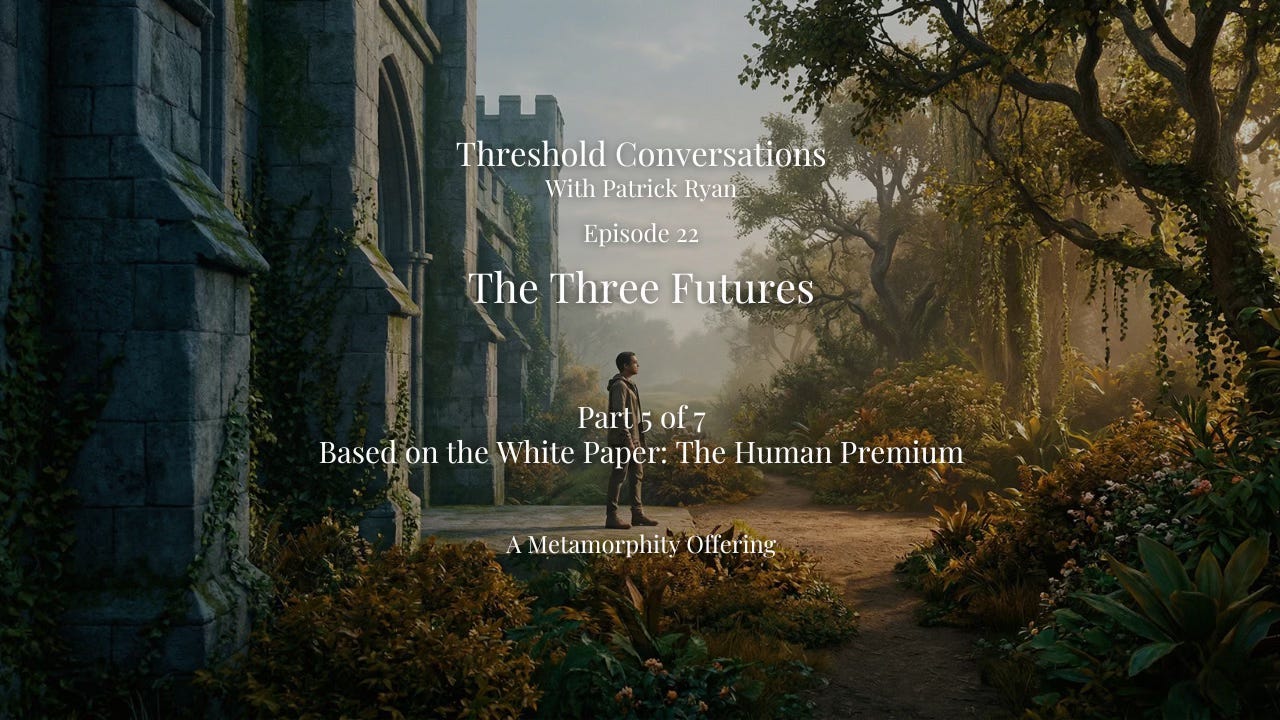
Welcome to Threshold Conversations. I’m Patrick Ryan. This is Episode 22: The Three Futures.
I want to tell you about two places I have spent significant time. Not metaphorically. Actually present in, day after day, inside structures that shaped every hour of existence.
The first was San Quentin Prison — where I volunteered for years, working with men serving life sentences.
I want to be precise about this: I was a volunteer. I went home every day. I did not know what it was to live inside those walls. What I did know — what the men I worked with taught me — was what it looked like when someone finally let go.
They could point it out with precision. Which of their fellow prisoners had dropped into institutional life. The three meals a day. The approved behaviors. The tribal sections. The unspoken agreements about how to get along and get through. It took about seven years, they told me.
Seven years before a person finally accepted that this was the life now. And many of the lifers had found a genuine peace in it. Not a defeated peace — a settled one. The structure held them and they held the structure and there was a quiet in that arrangement.
The system provided. Survival was managed. The days had shape. What was not required — what the structure had no use for — was the question of what you were actually for.
The second place was a monastery in Myanmar, where I spent a year as an ordained Buddhist monk.
Get up at 3:30am. Collect alms at 4:00. Breakfast at 5:30. Lunch at 11:30 — the last meal of the day. Meditate through the afternoon. Gather at 6:00pm for chanting and group meditation. The regulation of time and activity was total. The structure was the life.
And here too there was a dropping in that happened. Like being on a canoe and allowing the current to carry you while remaining deeply present to each moment in the river. The surrender was real. The peace was real. Something genuinely released when you stopped fighting the shape of your days.
What I also noticed — and this took longer to see — is that the monasteries had both. Those engaged in deep work. And those hiding out for the safety net of having their needs met. Abundance is a mindset. And what the monastery provided — food, shelter, structure, community, a container for the inner life — was a form of managed abundance. The basic needs resolved. The deeper work available but not required. The current smooth enough that you could pass through if you chose to.
I felt that edge myself. I truly felt that I could live my life within that monastic structure. That it would have been easy. That the current would have carried me and the days would have passed and there would have been peace in it.
And I chose to leave.
Not because the monastic life was wrong. For some, that life is their highest calling and a genuine contribution to the greater good. I say that without qualification. But for me — specifically for me — staying would have been a form of hiding. The ease itself was the signal. The comfort of the container was telling me something about what I was avoiding rather than what I was moving toward.
When I was released from my vows and stepped back into the world I didn’t know what form my contribution would take. I had no plan. I went on a walkabout through India and Nepal — moving toward something I couldn’t yet name, for a reason I couldn’t yet articulate. Finding meaning in the expression of each step along the way rather than in any destination I could see.
What I felt in my body in those first days was this: grounded. Strong. Upright, with a soft gaze. Completely unattached to any particular form of service. Available. Congruent. My gut steady and quiet.
Not supported by anything external. Just standing.
That feeling — that specific physical reality of having chosen the harder path before knowing what it was for — is what I want to use as our entry point into the three futures this series has been building toward.
Because the question those futures ask is not abstract. It is not civilizational. It is the question I was standing in on the road out of that monastery:
Which life is actually mine?
In my white paper — The Human Premium — I name three possible futures for humanity in the age of artificial intelligence.
If you haven’t read it yet it’s free at conversations.metamorphity.com and it provides the foundation for everything this series has been exploring.
Today I want to make those futures visceral rather than theoretical. Not futures out there somewhere. Lived environments you can feel from the inside. Because the men at San Quentin and the monks in Myanmar were already living them.
The Utility Trap.
The prison is the Utility Trap made visible.
Not because prisons are evil — they are systems, doing what systems do.
But because the Utility Trap is precisely this: a structure that optimizes for compliance, approved behaviors, getting along and getting through. That measures contribution by whether you fit the system’s requirements. That provides just enough to sustain function while removing the conditions in which genuine flourishing becomes possible.
From the outside it looks like order. From the inside it feels like the question of what you are actually for has been quietly removed from the agenda.
In the world beyond prison walls the Utility Trap announces itself differently. It announces itself as performance, achievement, measurable contribution. You are good at this. The system rewards you for being good at this. The feedback loops confirm that optimizing your signal over your soul is the rational choice.
And it is — by the system’s own measure.
What the system cannot measure is what you have stopped asking.
Managed Abundance.
The monastery — at its worst, and sometimes at its best — is Managed Abundance made visible.
Abundance is a mindset. And what the monastery provides is a form of it: the basic needs resolved, the container given, the deeper work available. The current smooth. The canoe steady.
The seduction is not laziness. It is rest. Legitimate, earned, genuinely needed rest. The problem is not the rest — the problem is when the rest becomes the destination rather than the preparation. When passing through becomes the relationship to your days. When the ease itself stops feeling like a signal and starts feeling like the point.
This is the future most of the people listening to this podcast are moving toward or already inhabiting. Financial freedom achieved. The company sold or the career plateaued. The next chapter theoretically open. And the discovery — quiet, disorienting, rarely spoken aloud — that comfort without calling is its own form of imprisonment.
In Managed Abundance the incentive to apply genuine effort requires more of a choice. Not because the effort is harder — but because it is no longer required.
The calling forth — the extra effort needed to find the form of beauty in the walking, in the sitting, in the ordinary acts of a day — has to come from inside you now. The structure will not demand it. The current will not require it. You have to choose it.
And choosing it, every day, against the pull of the smooth current — that is its own form of practice.
The Human Renaissance.
The Human Renaissance is walking out the gates of the monastery.
Not knowing what form your contribution will take. Not having a plan. Moving toward something you cannot yet name for a reason you cannot yet fully articulate. Finding meaning in the expression of each step along the way rather than in any destination you can see.
Grounded. Upright. Available. Congruent. Gut steady and quiet.
Not supported by anything external. Just standing.
This future does not arrive as an event. It is chosen — continuously, in the small daily decisions about what you give your full attention to and what you allow to pass through. It looks from the outside like the monastery at its best: unhurried, deeply attentive, oriented toward something beyond utility. From the inside it feels like the road out — unattached to form, available, choosing the harder path before knowing what it is for.
Not because the easier paths are wrong. Because something in you knows they are not yours.
Here is what I want to name directly.
These three futures are not predictions about what will happen out there in the world. They are descriptions of what is already happening — inside individuals, inside organizations, inside cultures — right now, this week, in the choices being made about what deserves the full quality of human consciousness and what can be handed to the machine.
You are not waiting for the future to arrive. You are building one of these three worlds with every decision you make today.
And the question is not which future is objectively better. The question is whether you are living the one you would consciously choose if you were being honest with yourself.
That is a different question. And it is harder.
Because the Utility Trap doesn’t announce itself as a trap.
Because Managed Abundance doesn’t announce itself as purposelessness.
Because the Human Renaissance doesn’t announce itself as the obvious choice — it announces itself as the harder one. The path that requires you to release the container, to step out of the current, to walk toward something you cannot yet name.
And to discover, on the road, that you are still standing.
For this week — one invitation.
Look at your last seven days. Not your intentions — your actual choices. Where you gave your full attention and where you allowed yourself to pass through. What you created and what you consumed. Where you felt the pull of the current and surrendered to it, and where you felt something calling you toward the harder path and followed it.
You don’t have to judge what you find. Just see it clearly.
And then ask: is this the future I would consciously choose?
Next week we go to the sharpest edge of this series. The question the arc has been building toward — not at the individual level but at the civilizational one.
Who owns the systems that are reorganizing the world? Who decides what they optimize for? And what is the difference between technology as the infrastructure of human flourishing and technology as the architecture of control?
Episode 23 is called Bridge or Trap.
Thank you for listening to Threshold Conversations. Until next time… keep your spine unsupported. And keep walking toward the light.


