

Welcome to Threshold Conversations. I’m Patrick Ryan.
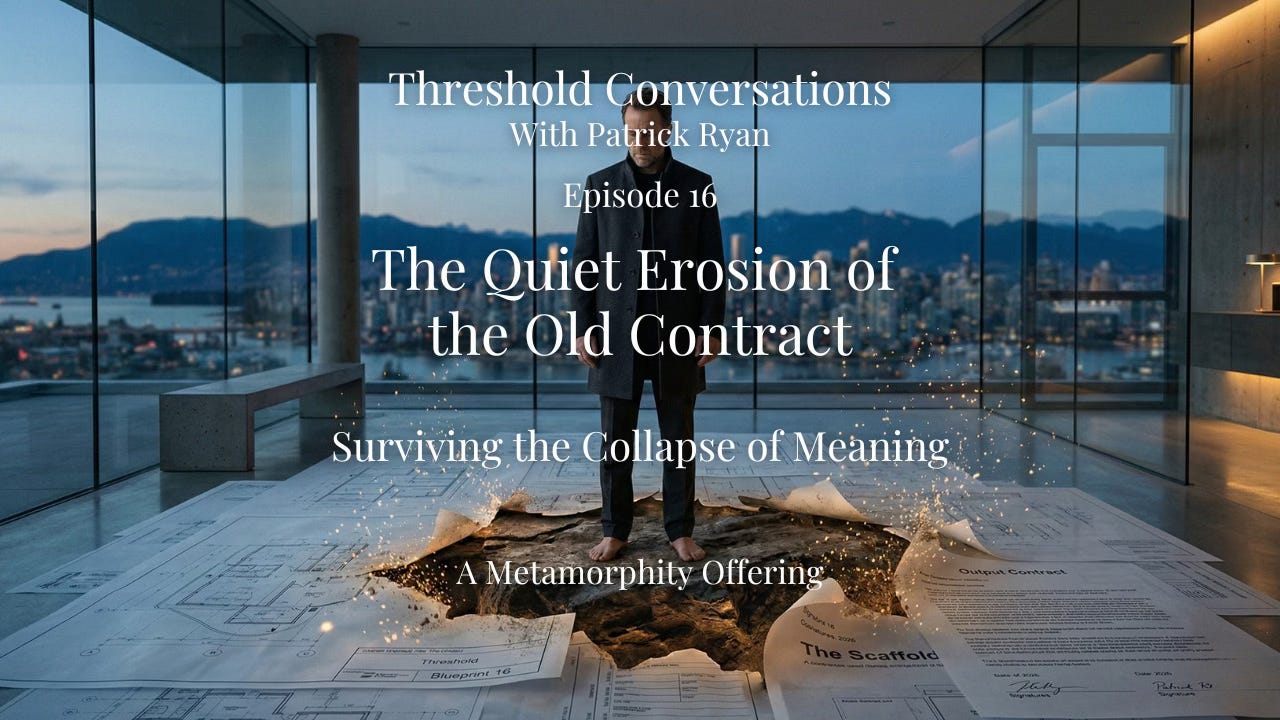
This is Episode 16: The Quiet Erosion of the Old Contract.
Before we begin, I want to name something that’s been clarifying over the last fifteen episodes.
When I started this podcast, I wasn’t entirely clear on what it was about or who it was for. I knew I was exploring thresholds—the collapse of old blueprints, the erosion of structures people thought were permanent, the question of what it means to navigate uncertainty when the map burns.
And through that exploration, something has clarified.
This isn’t about surviving AI disruption.
It’s about living resonantly in the Age of the Machine.
What does that mean?
It means we’re navigating a world where machines can do almost everything—except be present. Where utility is becoming free, and presence is becoming premium. Where the question isn’t “How do I stay useful?” but “How do I deepen what’s irreplaceable?”
Going forward, that’s the frame.
This is about building lives—individually and collectively—where what you do, who you work with, and the choices you make vibrate at the frequency of what actually matters.
Today, we’re starting with the foundation: understanding what’s eroding beneath the surface, and what remains solid when the old structures fall away.
Let’s begin.
Over the last few episodes, we’ve been building a framework for navigating uncertainty. And somewhere in those conversations, a question kept surfacing—usually around 3:00 a.m.:
If the old blueprints are dissolving, if the ladder is gone, what exactly am I navigating now?
The honest answer is this: we are navigating the quiet erosion of a contract most of us never signed but lived by anyway.
The contract said: “I bring my body, my attention, my skill—and in exchange, I receive security, dignity, a place in the world.”
It was never a fair contract, especially for those whose work was always embodied, always the last mile. But it was a contract. And now it’s being rewritten—not with our consent, but in real time.
Walk through any downtown today. Cafes are full. People sit in the sun, drink seven-dollar lattes, update LinkedIn with cheerful announcements. Outwardly, everything looks fine.
And for many, it still is. Paychecks clear. Calendars fill. The momentum of the old system carries people forward.
But beneath that momentum, something is quietly dissolving.
Not with fanfare. Not with breadlines or apocalypse.
With a slow, almost imperceptible loosening of the premise: “My output is what makes me matter.”
This is not the end of the world.
It is the end of an illusion—the illusion that utility and identity were the same thing.
Think of the old cartoon: the coyote runs off the cliff, legs still spinning in mid-air. He feels fine until he looks down.
Many of us are still mid-air. The residual speed of the old blueprint keeps us moving. The titles are still on the doors, the emails still arrive, the Zoom backgrounds still look professional.
But the ground—the premise that our usefulness guarantees our place—is no longer there.
When that realization lands, it can feel like a quiet unraveling. Not dramatic. Just the slow recognition that the ground you thought was permanent was always just momentum.
The lawyer who watches a language model do a week’s discovery in five seconds.
The consultant whose methodology now fits in a prompt.
The creative director who sees thirty seconds of AI output match three weeks of team work.
They are still showing up. Still delivering. Still smiling in meetings.
But privately they ask: If I am no longer the fastest, the sharpest, the most efficient… what is my life actually worth?
That question is not paranoia. It is perception.
You are sensing gravity before most people look down.
For the primary circle listening—those whose bodies have always been the job—this erosion lands differently.
It’s not abstract.
It’s the tightening when hours shrink, when the schedule questions your necessity, when the system that once extracted your presence now wonders if it can do without it.
The grief is real.
The quiet rage is real—”I showed up with my hands, my voice, my attention every day, and now even that feels optional.”
The disorientation is real—the body that was always required suddenly feels surplus.
And yet—here is the pivot. I’m not going to apologize for finding opportunity in difficulty, and I’m not going to bypass the real grief. Both are true.
This erosion is also an invitation.
When utility becomes free, presence becomes premium.
When information floods every channel, wisdom becomes rare.
When synthetic output saturates the market, authenticity becomes the only signal that cuts through.
This is not the end of value.
It is the beginning of a different economy—one where what remains uniquely human is finally recognized as the scarce resource.
So what does that look like in practice?
First, separate the self from the function—gently, daily.
When someone asks “What do you do?” notice the impulse to hand them a title as your entire answer.
Try answering from the ground instead: “I hold space in rooms where people are uncertain.”
Or: “I bring steadiness when systems tremble.”
Or simply: “I show up with my full attention.”
These are not job descriptions. They are orientations.
The more you practice naming yourself from presence rather than output, the less painful the erosion feels.
Second, double down on the un-automatable.
Not as a hustle tactic—as a reclamation.
In every interaction—with a patient, a client, a coworker, a stranger—there is a moment where presence is the only currency that matters.
A hand on a shoulder when words fail.
A pause that lets someone name what they’ve been avoiding.
A calm field when everyone else is spinning.
These moments don’t scale. They don’t optimize.
But they resonate.
And resonance is what attracts the next aligned opportunity.
Third, invest in relational infrastructure—now, while the old momentum still carries you.
Use whatever resources remain to strengthen your Sovereign Circle.
Fund a colleague’s training.
Buy time for a peer’s Sanctuary.
Hold space for someone else’s threshold.
This is not charity. It is architecture.
When the external validation thins, you won’t be standing alone—you’ll be standing in a field of resonance.
Tomorrow, go to a cafe.
Order your coffee.
Sit down.
Do not open your laptop. Do not check your phone.
Look around at the people typing furiously, taking calls, wearing the masks of productivity.
Do not judge them. Send them quiet grace.
They are running on momentum, and momentum eventually meets gravity.
Then turn the attention inward.
Ask yourself three questions—not to strategize, but to notice what arises in the body:
What am I still doing that drains my life force—even though I’m good at it?
Name it without explanation. That’s where you’re still performing utility instead of living from presence.
What would I do even if it never made money or impressed anyone?
Strip away validation. What still lights the spark? That’s your clean signal.
What am I doing because I “should”?
Circle every “should” on your calendar. That’s where the old contract still has its grip.
After the questions, protect five minutes of silence.
Notice what arrives in the body—without forcing an answer.
This is not preparation for collapse.
This is preparation for clarity.
The cafes will stay full for a while longer.
The paychecks will keep clearing.
The profiles will keep updating.
But beneath them, a new economy is already forming—one where presence, not output, is the ground.
And the people who thrive in it will not be the ones who ran fastest on the old scaffold.
They will be the ones who had the courage to stop running and stand in what remains uniquely human.
Thank you for listening to Threshold Conversations.
If you’re sensing the quiet erosion before most people look down—trust that perception.
It is not despair. It is the beginning of orientation.
Until next time…
keep your spine unsupported.
And keep walking as light.


