

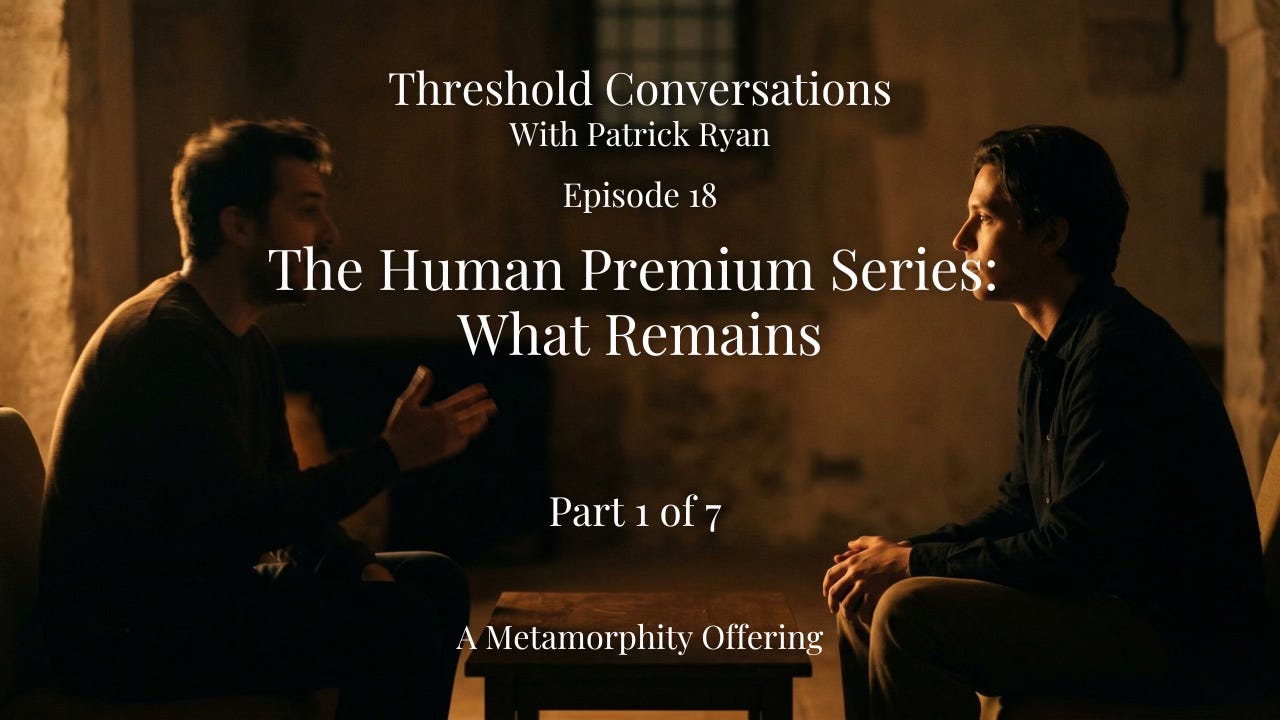
Welcome to Threshold Conversations. I’m Patrick Ryan. This is Episode 18: The Human Premium: What Remains.
Someone I work with recently — I’ll call him David, though that’s not his name — came to our session a few weeks ago carrying something heavy. He’d just been told his role was being eliminated.
Not performance-related. Not personal. The company was restructuring around AI tools that could now do in minutes what his team had spent years learning to do well. He was professional about it in the way that people are professional when they’re still in shock. Measured. Slightly too measured.
He sat across from me and began laying out his options. His voice had that particular quality I’ve learned to recognize — the voice of someone who has decided to think their way through something that hasn’t finished hitting them yet.
And I felt it. The pull. Thirty years of practice and I still feel it — the professional reflex to be useful, to help him sort the options, to move toward something constructive. To fix it. The Inner Manager in me wanted to get to work.
I didn’t. I waited.
Not because I had a technique for waiting. Because something in the room told me we weren’t ready. He wasn’t ready. The situation hadn’t fully landed in his body yet and if I moved toward solutions I’d be solving a problem he hadn’t yet fully felt. I’d be helping him skip the thing he most needed to move through.
So I stayed with the discomfort of not fixing it. His discomfort and mine.
And then something shifted. I can’t tell you exactly when or why. It wasn’t a word or a gesture. It was more like a change in atmospheric pressure. And when I felt that shift I moved — not to solutions but toward what was actually happening. This is a loss, I said. You’re allowed to feel that.
And he did. And from that place — not before it, not around it, but from inside it — he began to find his own ground.
What I did in that room wasn’t information. It wasn’t expertise, though thirty years of practice informed every second of it. It wasn’t efficiency — waiting is the opposite of efficient. What I brought into that room was something older and harder to name. And the question I’ve been sitting with ever since is this:
What was that? And what happens to it in a world where machines are doing more and more of the work?
That question is what the next six episodes are about.
We’ve spent seventeen episodes — the Scaffold series — walking through what the AI transition is dismantling.
The structures of role, utility, and identity that most of us mistook for ourselves. The Jet Stream of busyness that keeps us moving too fast to feel how much has already changed. The Ground beneath all of it — the layer of actual meaning that was always there, waiting, largely unvisited.
That series asked hard questions about the external world. This one gets more personal. More uncomfortable. Because the territory we’re entering now isn’t about what the machines are doing to us. It’s about what we’re capable of — and whether we have the presence of mind, and body, to claim it.
This is The Human Premium Series. Seven episodes.
A single sustained inquiry into three capacities that may be humanity’s most irreducible contribution in an age of artificial intelligence — Presence, Coherence, and Beauty.
I’ve also just published a white paper by the same name. The Human Premium. It’s free — you’ll find it at conversations.metamorphity.com or you can get the pdf from my website at PatrickRyan.COACH.
I’d encourage you to read it, not because it resolves anything, but because it names what many people are feeling without yet having language for. If you’ve ever sensed that the AI conversation is missing something essential about what it means to be human — that paper is written for you. These episodes will extend and challenge it. But the paper is the foundation, and it’s there if you want to go deeper.
Back to that room. Back to David.
What I was doing in those minutes of waiting was not nothing. It was perhaps the hardest thing I know how to do — and the thing I am most convinced cannot be automated.
I was present. Fully, uncomfortably, without an agenda.
I was suspending my own need to be useful in order to be genuinely with him. I
was reading something the situation wasn’t saying out loud — the quality of his breath, the tension in the way he held his shoulders, the almost imperceptible moment when the professional composure began to soften. I was waiting for a signal that no algorithm could detect because it doesn’t live in language or data. It lives in the field between two human beings who are actually in contact with each other.
That quality — being so fully in contact with another person that what they most need becomes apparent, not through analysis but through attunement — that is what I mean by Presence.
Not a soft skill. Not emotional intelligence rebranded. Something more fundamental. Something that requires a body, a history, and the willingness to be genuinely affected by another human being.
And from presence, if you stay with it long enough, something else emerges.
Call it Coherence — the quality of being genuinely integrated, not performing okayness while feeling something else entirely.
When David finally let the loss land, he became more coherent, not less. More himself. The professional composure was the fragmentation. The grief was the coherence.
And from that coherence — this is the part that still moves me — something beautiful became possible.
Not beautiful in a decorative sense. Beautiful in the sense that he began to speak about his life from a place of actual truth. What he wanted. What he’d been avoiding. What he might build if he stopped organizing his life around what was expected of him.
Presence. Coherence. Beauty. Not a sequence you manufacture. A sequence that arises when you create the conditions for it.
That is the Triad of Resonance. And that is what I mean by the Human Premium.
Here is the question I want to leave with you before next week — and I’m not asking it rhetorically.
What I did in that room with David: could a machine do it? Not a crude chatbot. Something sophisticated. Something trained on every therapy transcript, every coaching session, every moment of human attunement ever recorded.
Something that could read micro-expressions, vocal patterns, the subtle shifts in language that signal readiness.
Could it wait for the right moment the way I waited? Could it feel the atmospheric change in the room? Could it hold its own discomfort — its own reflex toward efficiency — and choose to stay?
I have a view on this. But I want you to sit with the question first. Because the answer matters enormously — and it’s not as simple as we’d like it to be.
Episode 19 is called The Counterfeit. We’re going there next week.
For this week — one small invitation.
In your next conversation — not a coaching session, not a professional context, just a conversation with someone you know — notice the moment when you feel the pull to fix, to advise, to move toward something useful.
And wait. One beat longer than feels comfortable.
Don’t manufacture presence. Just notice what’s actually in the room. What the person in front of you is actually carrying. What they might need that isn’t a solution.
You don’t have to do anything with what you notice. Just notice it.
That noticing — that capacity to be with rather than do to — is what we’re exploring in this series. It may be, I want to suggest, one of the most important things you can cultivate right now. Not despite the age we’re living in. Because of it.
What remains when machines take the work?
I’ve been sitting with that question for months. It arrived the way most important questions arrive — not as an intellectual puzzle but as something felt. A weight. A wrongness I couldn’t quite name.
But lately the question has been turning. Quietly, without announcement. And what I notice now — what that room with David keeps pointing me toward — is that the question itself may need to change.
Not what remains. But what opens up.
Because something did open in that room. Not despite the disruption — because of it. The stripping away of what David thought his professional life was made space for something truer to become visible.
Something that had been there all along, waiting beneath the scaffold of role and utility and the relentless pressure to produce.
That’s what I think the machine transition is doing at civilisational scale.
Stripping the scaffold. And the question — the one that will occupy us for the next five episodes — is whether we have the presence, the coherence, and the courage to meet what’s underneath it.
Not what remains. What opens up.
That’s where we’re going.
Thank you for listening to Threshold Conversations. Until next time… keep your spine unsupported. And keep walking toward the light.


