

Welcome to Threshold Conversations. I’m Patrick Ryan. This is Episode 20: The Hum.
I want to take you back about thirty years. I was working as an electrician on a large industrial job — a hydroelectric power plant. I’d been assigned to terminate hundreds of wires inside a substantial electrical cabinet. Control system wiring. The kind of work where getting it wrong has consequences.
I remember the first day clearly. Not because anything notable happened — because of what was happening inside me. My chest was tight. My shoulders were carrying the whole job. The pressure to get it right, the time constraints, the weight of the responsibility — all of it had found its way into my body and was sitting there like a stone.
I was in my head. Completely in my head. Worried about the outcome before I’d properly begun.
At some point — I can’t tell you exactly when, it took a day or so — I noticed what I was doing to myself. The tightening. The bracing. And I made a decision that seems simple in the telling but wasn’t simple at the time.
I took a few long, slow breaths.
I recognized that what I had in front of me wasn’t just a task to survive — it was an opportunity. I gave myself permission to enjoy the process, not just deliver the outcome. And then I did something that had taken me years to learn how to do: I let go of the performance of it.
The need to be seen getting it right. The anxiety about how it would be judged. I dropped into the work itself.
What happened next is still difficult to describe precisely. Once I realized I had an opportunity rather than a burden, it was a very quick trip to a different place. My heart joined the work. My head knew what had to be done. My gut relaxed because I was finally being congruent — aligned between what I was doing and how I wanted to be doing it.
I stopped simply wiring the cabinet and started shaping it.
Each wire found its path in intentional right angles. Nothing cut across a shortcut. The arrangement began to develop an internal logic that went beyond function — into something closer to form. I dropped into a zone I can only describe as full inhabitation. The work absorbed me completely. Time did something different. The tightening in my chest was gone.
When the job was done, the cabinet would be closed. In all likelihood no one would ever open it again. There was no audience for what I was making. No one had asked for it. The extra care would go unrewarded in any conventional sense.
But I knew how it felt — in my chest, in my hands — to elevate a technical task into something that asked everything of my attention.
And there was a hum.
Not a sound exactly. More like a quality of aliveness that emanated from the work. A frequency I could feel before I could name.
What surprised me was what happened next. Over the course of that week other workers began drifting over. People from other parts of the job site — people who had no reason to be in that room — started appearing. They would stand and watch for a while without saying much. They would nod. Then they would go back to their own work.
Afterward, people talked about it. And I noticed — though I said nothing — that the quality of work around me lifted. Not because I had instructed anyone or made any claim. Simply because something had a frequency, and those who were available to it came into resonance with it.
I have thought about that week many times since. About what actually happened in that cabinet room. About what the hum was and where it came from and whether it can be explained.
I think I understand it better now than I did then.
Beauty has a hum.
Not beauty in the classical sense — though symphonies and paintings and great architecture carry it too. I mean something more fundamental. A quality of aliveness that emanates from any act performed with full consciousness. It doesn’t begin in the output. It begins in the person doing the work, before the work takes its final form.
It is a state of consciousness. And it is available in any act, in any domain, to anyone willing to arrive at it.
I want to prove that to you. Not with an argument. With a man I’ll call Joe.
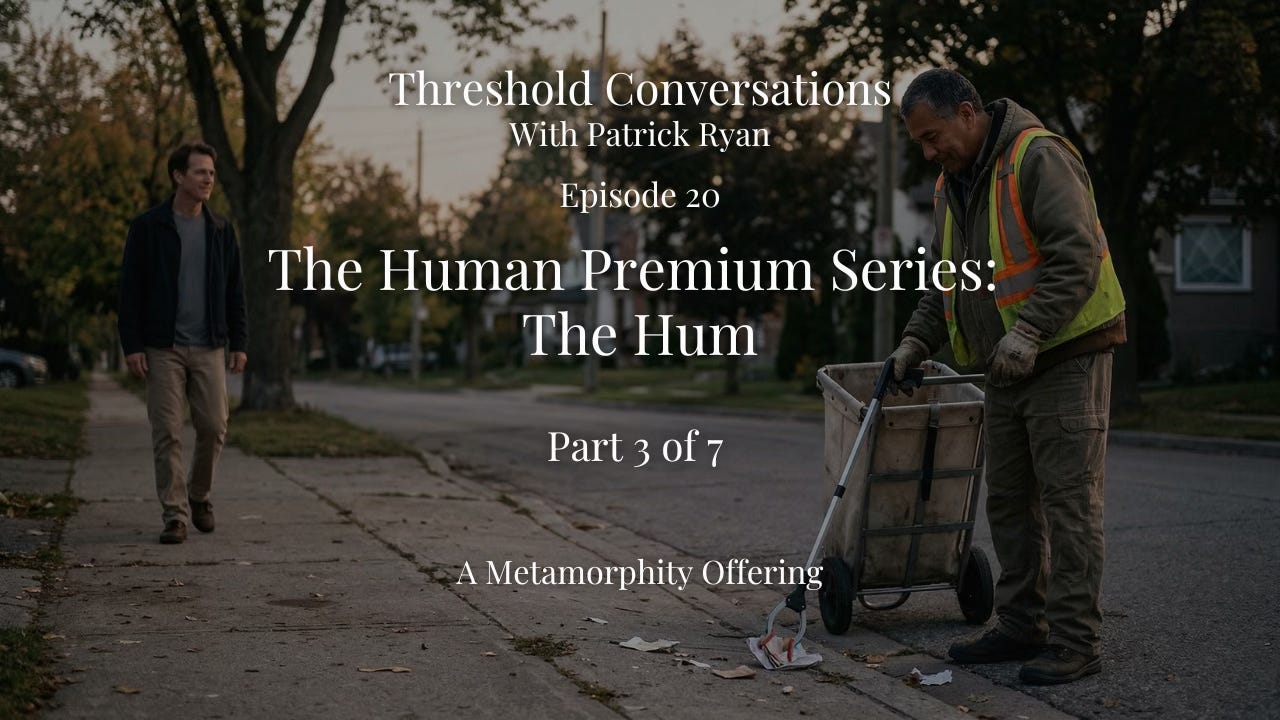
Most mornings I go out for a walk in my neighbourhood. And most mornings, on a particular stretch of street, I see the same man. Joe works for the city — his job is to collect litter. He has a cart and one of those articulating grabber tools, and he moves through the streets picking up bits of paper, retrieving what the wind has scattered, keeping his patch of the city clean.
He keeps his head down. He minds his own business as he goes about his. You could walk past him every morning for a year and never really see him.
But I noticed something. The peace with which he moves. The meticulousness. He misses nothing. Not in an anxious, checking way — in a complete way. He is fully in his work. Fully present to what is in front of him.
I started initiating brief exchanges as I passed. A greeting. An acknowledgment. And what I found was a man who was completely available to be met — warm, present, unhurried, even in the middle of his work. Sometimes I’d see him checking in on people who appeared to be homeless. Sharing a few words. Offering information while respecting boundaries. Quiet dignity in both directions.
What Joe does is not glamorous. It is not skilled in any conventional sense. It will not appear on anyone’s list of meaningful contributions. And yet what moves through him as he does it — that quality of peace, of meticulousness, of genuine care for the patch of world in front of him — that is the hum. Unmistakably.
The workers drifted over to watch me wire a cabinet. I cross the street to say good morning to Joe. We are drawn to the same thing. The frequency of a human being fully alive in the act of making — or in Joe’s case, the act of tending.
He doesn’t make it about him. That’s the thing I keep coming back to. There is no performance in what he does. No audience being managed. He has arrived at something — through whatever path his life has taken — that I spent years learning to access. And he carries it without announcement, without agenda, without the need for anyone to notice.
That is beauty. Not as an aesthetic category. As a transmission.
Now let me say something about artificial intelligence. Because this is the series that asks what remains uniquely human, and beauty is where the question gets most philosophically interesting — and most frequently misunderstood.
The argument is not that AI cannot create beautiful outputs. It can. AI-generated music moves people. AI-generated ima ges evoke genuine response. The outputs can be indistinguishable from human-made beauty, and by certain measures they sometimes surpass it.
The distinction is this: AI has no interior state from which beauty flows.
It cannot spend a day and a half with its chest tightening before deciding to take a breath and redirect. It cannot learn — over years of practice — to release the performative instinct and drop into congruence. It is not on a developmental journey. It does not grow in its capacity to bring more of itself to the act, because it has no self to bring. It cannot tend a stretch of street with the quiet dignity of a man who has found his way to peace with the work in front of him.
The output may look identical. But what moves through it is different.
The receiver may not always be able to name the difference. But some will feel it — in the quality of attention that arises in them afterward. In whether the encounter leaves them more alive or simply more informed. The hum has a frequency. Those who are available to it come into resonance with it.
The transmission is absent from AI-generated beauty not because the output is inferior. But because there is no one home doing the transmitting.
I said earlier that what I did in that cabinet — the redirecting, the permission, the dropping in — was something I had to learn. It didn’t come naturally. I had to develop the capacity to stand in what I call the Sovereign Spine — to release the need for external validation, to let go of the performative instinct, to act from inside the work rather than from above it watching myself work.
That development took years. It still takes attention. There are days when the chest tightening wins, when I deliver the functional version of what I’m capable of and nothing more.
But here is what I want you to hear: Joe didn’t need thirty years of contemplative practice to arrive at his hum. He arrived by a completely different path — through whatever combination of character, circumstance, and quiet daily commitment brought him to that stretch of street, moving with that quality of peace, missing nothing.
Same hum. Different journey.
Which means this is not a capacity reserved for people with particular training or particular temperament or particular domains of work. It is available to the electrician and the garbage collector and the parent and the executive and the athlete and the nurse. In any act. In any domain.
The question is not whether you have access to it. The question is whether you treat it as central or peripheral to how you move through your days.
For this week — one invitation.
Find one act in your week — one ordinary, unremarkable act — and decide before you begin it that you will bring everything you have to it. Not for the outcome. Not for anyone watching. For the act itself.
It could be a meal prepared. A report written. A conversation given your full attention. A stretch of street tended.
Don’t manufacture the hum — you can’t manufacture it. But create the conditions. Take the breath. Give yourself permission to enjoy rather than endure. Let your heart join the work your head already knows how to do.
Notice what happens in your chest when you arrive there. And notice — if you do — whether anything in the room around you changes.
Next week I want to tell you about a moment I witnessed dozens of times and never tired of. Twenty people standing in a circle. Each sounding their own note. The room hunting for something — reaching, almost finding it, settling back, reaching again. And then, at a moment that could not be forced or planned, every voice landing on the same tone simultaneously. The hair on your arms standing up. The room becoming an instrument.
That’s where we’re going.
Episode 21 is called The System of Us.
Thank you for listening to Threshold Conversations. Until next time… keep your spine unsupported. And keep walking toward the light.


