

In the last few conversations, we have been building the architecture of survival. We found our bearings. We formed our circles. We established the internal physics of the Deployed Node. We’ve moved from the isolation of the “stomach-drop” into the structural stability of the Sovereign Circle.
But there is a question that inevitably follows all of this structure. It doesn’t arrive during the day when we are busy being productive. It usually arrives around 3:00 a.m., when the Inner Manager wakes up, stares at the ceiling, and starts running scenarios against a world that no longer makes sense.
The question is: “Okay. I have my spine. I have my circle. I have my bearings. But how do I actually move when I cannot see the path?”
Because here is the reality of 2026: The landscape is shifting faster than you can map it. The old approach—analyze the terrain, build the five-year plan, and execute with precision—is a ghost dance. It is an industrial-age ritual applied to a liquid-age problem. By the time you finish drawing the map, by the time the committee signs off on the strategy, the territory has already changed. The doors you were aiming for have vanished, and new ones have opened where the wall used to be.
So today, we are going to talk about something much harder than planning. We are going to talk about the Internal Physics of Movement.
How to move through uncertainty without forcing it. How to partner with what is emerging before you fully understand what it is. How to be responsive instead of reactive when the floor beneath you is in a state of constant fallout.
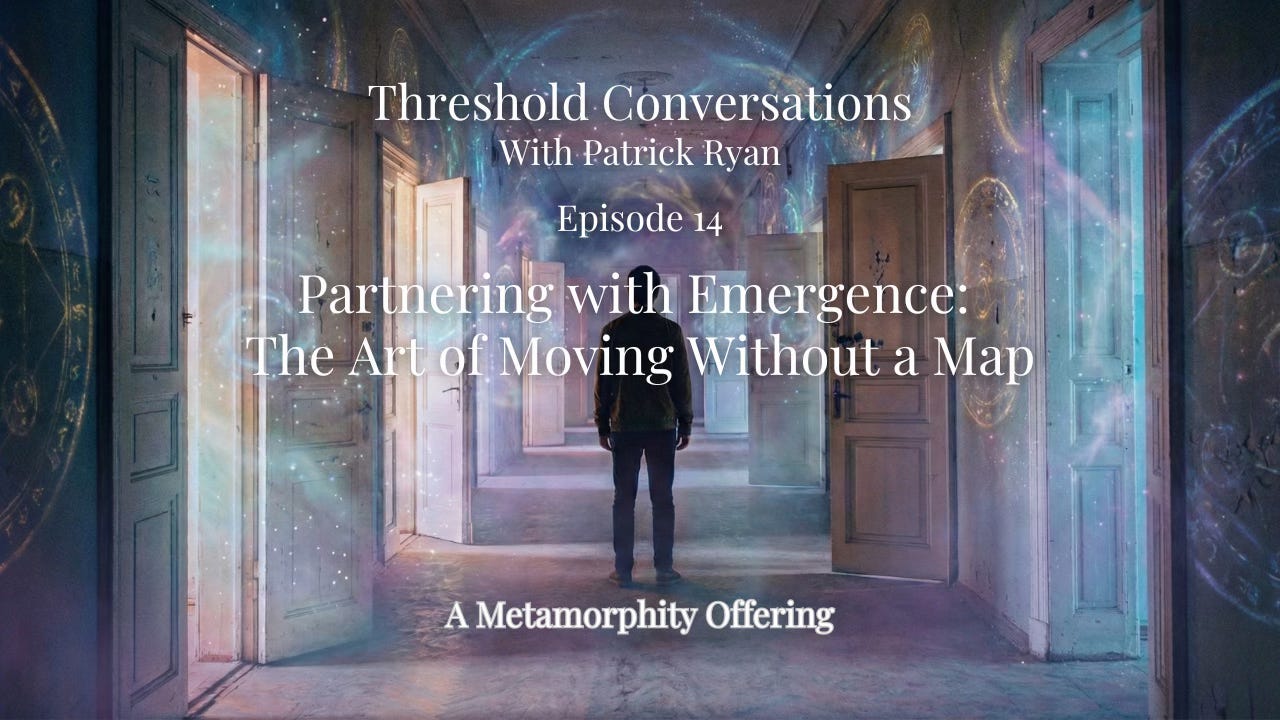
The Hallway of Emerging Doors
Imagine you are standing in a hallway. But it is not a static hallway. It is breathing. It is alive.
Doors are opening and closing all around you. Some stay open for a long time, inviting you in, and then quietly click shut just as you reach for the handle. Others crack open just enough to let a sliver of golden, amber light through, and then violently slam.
You cannot see what is behind them. You don’t know where they lead. You don’t know if there is a floor on the other side or another threshold. And you cannot stand still forever, because the floor beneath you is moving. It’s sliding toward a future that hasn’t been written yet.
That is what navigating the fallout of 2026 feels like.
The old world—the world of guaranteed utility—would tell you: Map the hallway. Figure out which door is mathematically “correct.” Analyze the risk. Build a robust strategy. Get more data.
But the new world requires a different nervous system. It requires you to learn how to sense which door is opening now. To feel, in the marrow, whether it is your door. And to have the “Skeletal Integrity” to step through it when the timing is right—even when the destination is entirely obscured by fog.
This is what I call Partnering with Emergence.
The Story of the Open Door
Let me tell you what that actually looks like in practice. Not in a textbook, but in the field.
A few months ago, a door opened for me. It wasn’t a job offer. It wasn’t a clean, scoped contract with a clear ROI. It was just... a conversation that lingered.
Someone I had met briefly reached out. They had a question about something I’d written regarding the “Human Premium.” We talked. It wasn’t a pitch. It wasn’t a sales call. But the conversation had a specific, undeniable energy—a resonance that felt like a return ping from a deep sonar.
At the end of an hour, they said, “I don’t know what this is yet, Patrick, but it feels like something. Can we keep talking?”
Now, here is what the Inner Manager did with that ambiguity: He panicked. He wanted clarity immediately. He started screaming for the architecture. What’s the scope? What’s the timeline? What’s the deliverable? What am I signing up for? How do we bill for ‘talking’?
I didn’t have answers to any of that.
The old version of me—the architect who needed the Scaffold before the building—would have said, “Call me when you know exactly what you need. My time is for utility, not for wandering.”
But something else in me—that quieter, deeper frequency underneath the panic—said: This door is open. Do not force a label on it. Do not try to mine it for utility yet. Just walk through.
So I did.
We had more conversations. Still no clear plan. Still no defined outcome. The Inner Manager was losing his mind. But something was emerging in the space between us. A nucleus of opportunity was forming that neither of us could have planned.
Slowly, over weeks, the fog cleared. It turned out they didn’t need a coach or a strategist in the traditional sense. They needed a Witness. They needed someone to hold the room and help them see what was actually happening in their organization while they were too close to the fire to see it themselves.
That work—work I could never have pitched, work that they didn’t even know existed—became one of the most meaningful and lucrative engagements I’ve had in years. But it only happened because I was willing to walk through a door I couldn’t see through.
The Fracture of Forcing
Here is the truth about forcing: When you try to bend reality before it is ready, it breaks.
I’ve watched this happen constantly in the 2026 fallout. I see it in Victoria, I see it in the digital nodes.
The entrepreneur who forces a business pivot out of sheer panic, before they’ve really understood the shift in the market—and the pivot accelerates their failure.
The founder who scales too fast because the money feels “hot,” before the structural foundation of their circle is solid—and the whole thing collapses under its own weight.
The creator who forces a “viral” signal because they are afraid of the silence—and they end up attracting a crowd that doesn’t resonate with their “One Inch” of truth.
Forcing before readiness does not create movement. It creates fracture.
But here is the paradox: You also cannot just sit passively and wait for absolute clarity to arrive.
Because clarity does not arrive when you are sitting still. Clarity is a byproduct of movement. You find out if the door is yours by walking toward it, not by staring at it from across the hallway.
The skill of 2026 is this: Learning to sense when the tension is right. When the door is actually open—not just cracked, but open. And then moving with it. Not pushing it. Partnering with it.
Reactive vs. Responsive
There is a massive difference between being Reactive and being Responsive. They look similar from the outside, but their internal physics are entirely different.
Reactive movement is fear-based. It is driven by the scarcity of the Rim. You see a door crack open and the Inner Manager screams: “I have to go through that right now or I’ll starve! I’ll be obsolete! I’ll be replaced by a machine!” You scramble. You rush the threshold without even checking if the room belongs to you. You trade your spine for the illusion of a quick win.
Responsive movement is grounded at the Axis. You see the door open. You feel the draft. And you ask the body: Is this my door? Is the timing correct? Does this resonate with my One Inch?
And if the answer is yes, you move. Not out of panic. Out of trust.
The difference shows up instantly in your nervous system. Reactive movement feels like Urgency. Your chest is tight. Your breathing is shallow. Your eyes are darting. Responsive movement feels like Flow. Your spine is upright. You are walking with gravity, not against it. You are “North.”
Same door. Completely different energy.
The Seven Bearings
So, how do you stay responsive when the world is melting?
You need a diagnostic tool. In the past, I’ve called this the Modern Heptad, but let’s be more practical. You need your Seven Bearings. These are the seven internal cardinal points that allow you to find your North when the map is burning.
Before you step through a door, run this check:
Attunement: Does my body say “Yes”? Forget the logic for a second—what does the gut say?
Sovereign Integrity: Does this door require me to trade my spine for safety? If I have to lie about who I am to enter, the room is a cage.
Signal: Is this aligned with my “One Inch” of truth? Am I stating my resonance, or just marketing for attention?
Vitality: Will this room give me life force, or drain it? Some doors look profitable but are actually parasitic.
Boundaries: Can I protect my Scholé—my unhurried space—while doing this?
Resonance: Is the timing correct, or am I forcing it out of fear?
Orientation: Does this move me toward my “Point of Presence,” or away from it?
If the door passes those bearings—walk through it.
Even if you can’t see the far wall. Especially if you can’t see the far wall.
Trusting Your Capacity
Third: You need to trust your Capacity.
Here is the ultimate fear that stops the deployment: “What if I walk through the wrong door? What if I can’t handle what’s on the other side?”
After decades of walking through doors I couldn’t see through, here is what I know to be true: You don’t need to know what’s on the other side. You just need to trust that you have the capacity to work with whatever is there.
Your intellect. Your intuition. Your ability to hold Presence. Your Sovereign Circle standing back-to-back with you. That is enough.
You are not fragile. You are not a porcelain doll that is going to shatter if you get a move “wrong.” You are a Monad. You are an adaptive, sovereign being. If you walk into a room and it’s not for you, you will learn. You will adapt. You will partner with the new data and find the next door.
The Internal Threshold
Let me tell you about the moment I had to test this myself.
There was a season recently when something fundamental was ending. Not a job. An identity. I had been working in a certain structure for years. It was fine. It was lucrative. People valued it. But something underneath kept whispering: “This isn’t it anymore. The frequency is dead. You are performing a ghost of yourself.”
The Inner Manager fought that whisper brutally. “Don’t unsettle things. You have a good thing here—why burn the map? Think of the security!”
But the whisper didn’t stop. It never does. And finally, I had to choose. I could force the old structure to keep working—grip the wheel tighter, perform a little harder, convince myself the ghost was still breathing.
Or I could let it die. And walk toward a door I couldn’t see through.
I chose the door.
And for months... nothing looked impressive. I wasn’t launching anything. I wasn’t scaling. I was just sitting in the silence of my own office. Noticing what wanted to emerge. People around me got confused. “What’s the plan, Patrick? What’s the strategy?” I didn’t have an answer. I just had my bearings.
Until one morning, in my Sanctuary of Time, it clarified. Not as a business plan, but as a physical knowing. This is the work. Presence. Thresholds. Helping people navigate when the map burns.
From that single knowing, everything else organized itself. The podcast. The frameworks. The clients who needed exactly this frequency. I couldn’t have planned it. I could only partner with it.
Conclusion: Walking Through the Fog
The old world said: Know the outcome. Build the plan. Execute. The new world of 2026 says: Stand upright. Sense the opening. Trust your capacity.
You stop demanding certainty before you move. You stop forcing doors that aren’t ready. You trust the Observer—that part of you that watches the panic but does not participate in it.
And eventually, when you have moved through the fog long enough, there is a moment. A moment when it all clarifies. And you realize you are standing exactly where you were meant to be. Not because you executed a perfect strategy, but because you trusted the emergence.
So tomorrow morning, in your Sanctuary of Time, do not write a to-do list. Ask yourself this:
What door is opening right now that I am afraid to walk through?
What am I forcing that isn’t ready yet?
Where am I being reactive instead of responsive?
Do not force an answer. Just sit with the questions.
The world is not slowing down. The hallway will keep moving. You don’t need a map. You just need your Bearings, your Capacity, and your willingness to step over the threshold.
Thank you for listening to Threshold Conversations.
If a door is opening and you’re afraid to walk through it—pause. Check your Seven Bearings. Trust your Capacity. And if it’s your door... walk through it.
Until next time… keep your spine unsupported. And keep walking toward the light.


