


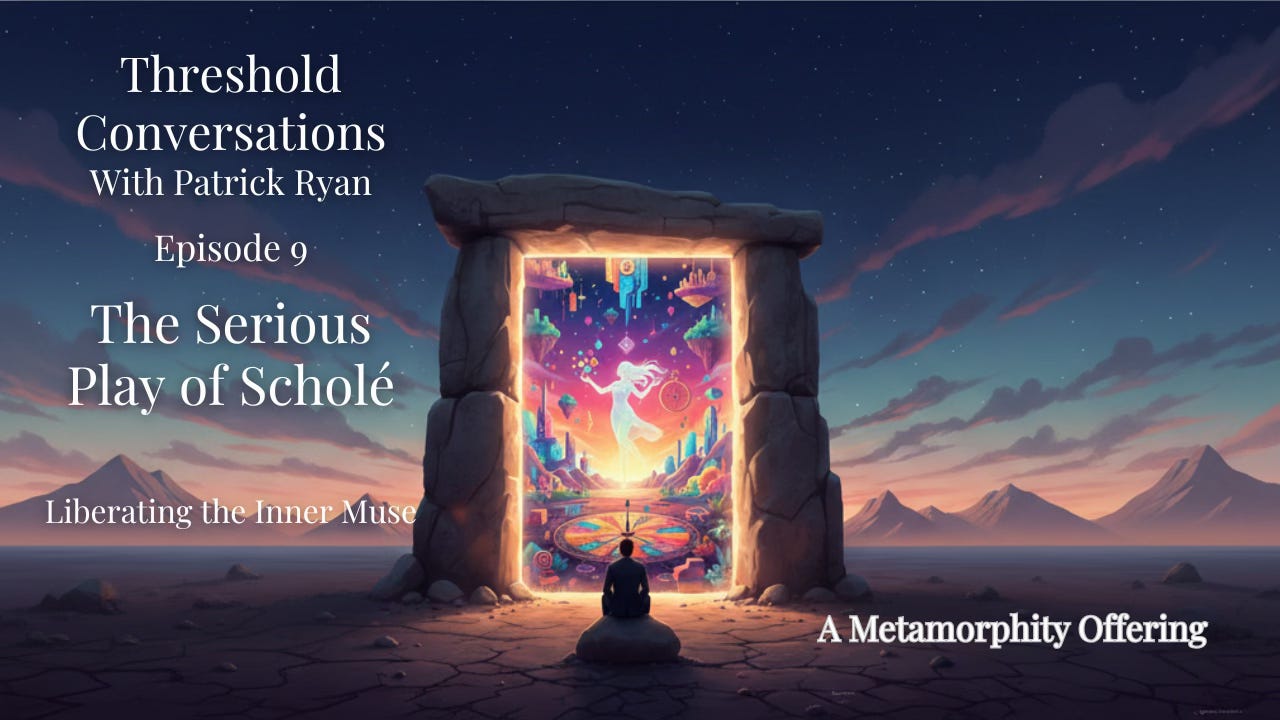
Welcome to Threshold Conversations. I’m Patrick Ryan.
This is a space for those who find themselves at the edge—the edge of a career pivot, the edge of a new venture, or perhaps that more subtle, quiet edge where you realize that the strategies that got you here are no longer enough to take you where you are called to go.
Today, we are talking to the builders. I’m speaking to the founders, the solopreneurs, the visionary leaders of teams, and the creators who are navigating the high-voltage challenges of our modern landscape. We are going to discuss something that sounds deceptively simple, yet is perhaps the most difficult thing for a high-capacity person to do: We are going to talk about play.
But I want to be clear—I am not talking about “play” as an escape from your work or a weekend distraction. I am talking about playtime with your inner muse. I am talking about a disciplined, radical reclamation of your imagination. Because in this world of now—a world that is increasingly automated, algorithmic, and optimized to the point of exhaustion—your ability to “play” with the source of your reality is the only true competitive advantage you have left. It is the fundamental difference between managing a system and manifesting a vision.
To understand why this is so critical, we have to look at a few ancient maps that help us navigate this modern threshold. We have to look at the philosophy born in a prisoner’s cell, the lost meaning of “leisure,” and the raw, transformative silence of the desert.
The Executive’s Shadow: The Tyranny of the Useful
If you are listening to this, you are likely an expert at “The Grind.” You have spent years learning how to take an idea and subject it to the pressures of the market. You know how to optimize, how to push, and how to prove your worth through output. We live in a culture of Ascholía—a Greek word that literally translates to “non-leisure” or “busyness.”
For the entrepreneur or the founder, Ascholía is the very air you breathe. But it has taken on a new, more insidious form. Our current digital landscape—the infinite scroll, the algorithmic feed, the constant notifications—is designed to keep you in a state of “digital busyness.” This isn’t just about productivity; it’s a form of high-tech capture. The algorithm thrives when you are reactive, when you are constantly “useful” to the machine. Your brain has been trained to ask: “Is this meeting useful? Is this thought productive? Is this hour billable?”
We have become obsessed with the “How” and the “When,” but we have lost the “Why.”
There is a dark shadow to this relentless utility. When we treat our minds purely as tools for production—as hammers meant only for hitting nails—we turn our inner muse into a weary factory worker. And eventually, as many of you know, that factory worker goes on strike. That is the “quiet ache” so many of you feel in the middle of the night—the sense that while you are the “source” of your business, you have become dangerously disconnected from the “source” of your own inspiration. You are running the grid, but the generators are humming at a frequency that no longer feels like music.
In this environment, “Play” isn’t a soft skill. It is a radical act of rebellion. It is a gritty, intentional stand against an automated world that wants you to be a predictable node in a network. To play is to be delightfully unpredictable.
Inspiration Source 1: Boethius and the Useful “No”
To find our way back to that music, let’s look at a man who lost everything. In the 6th century, a Roman statesman named Boethius was one of the most powerful and respected men in the world. He was at the pinnacle of his career until, in a sudden turn of political fortune, he was accused of treason. He was stripped of his wealth, separated from his family, and thrown into a cold prison cell to await execution.
In that “threshold” moment—suspended between a life of immense power and the finality of death—he didn’t surrender to despair. Instead, he wrote one of the most influential books in Western history: The Consolation of Philosophy.
Boethius realized something profound that every founder needs to hear today: “Bad fortune” is often more useful than “good fortune.” This sounds like heresy in a boardroom, doesn’t it? But Boethius’s logic was ironclad. He argued that good fortune deceives us. It seduces us into thinking we are in absolute control of the “Wheel of Fortune”—that as long as we work hard enough, the market will always climb, the team will always stay, and the economy will always favor us. But “bad fortune”—the “No,” the failed launch, the quiet prison cell—strips away those illusions. It forces us to stop trying to manipulate the external world and begins the far more important process of reclaiming the internal one.
Boethius found his muse not when he was the boss, but when he was the observer. He realized that even in chains, his ability to think, to imagine, and to play with eternal truths remained untouched by the King who imprisoned him. He discovered that his inner reality was the only thing that was truly “real.”
Inspiration Source 2: Scholé—The Lost Art of Being
This brings us to a concept that serves as the foundation of my coaching work: Scholé. In our modern world, we’ve corrupted this word. We turned it into “School”—a place of testing, labor, and standardized metrics. But for the ancient Greeks, Scholé meant “Leisure.”
However, their version of leisure wasn’t about “vegging out” in front of a screen or scrolling through a digital feed to numb the mind. It was “undistracted time for the pursuit of truth.” It was the act of being intentionally “useless” in the eyes of the market so that you could be “useful” in the eyes of the soul.
For a solopreneur or a founder, Scholé is what I call the “Containment Field.” It is the intentional boundary you draw around your mind to say, “For this window of time, nothing is being optimized. Nothing is being sold. I am not a CEO, a manager, or a provider. I am simply playing with the Muse.” Without Scholé, your imagination is just a high-priced problem-solver, churning through the same old data. With Scholé, your imagination becomes a world-builder, capable of seeing the structures that don’t even exist yet.
The Desert Solo: A Rite of Passage for the Mind
For years, I guided leaders on desert retreats—people just like you, founders and creators who were standing at their own personal thresholds. The core of that experience was three days of absolute solo time. I would ask them to choose a “spot” in the wilderness, and then I would ask them to stay there. No books, no phones, no journals, no “to-do” lists.
The desert is a literal laboratory for Scholé. It mimics what physicists call the “Quantum Field”—a place where all possibilities exist in a state of potential, but nothing has yet “collapsed” into a fixed, rigid result. When you sit in your “spot” for three days, you go through a specific, unavoidable metamorphosis:
The Resistance: Initially, your Ascholía mind—the “Manager”—screams at the silence. It tries to organize the rocks into patterns. It plans next year’s projects. It panics about the time being “wasted.” This is your ego trying to maintain the scaffold of your identity.
The Collapse: Eventually, the “Manager” in you gets exhausted. It realizes it has no utility here. It can’t “fix” the desert. This is the Boethian moment—the stripping away of the role to find the soul.
The Muse Emerges: Once the manager goes quiet, the Muse finally starts to play. You start to notice the subtle way the light moves across a canyon wall. You start to see connections between the ecosystem of the desert and the ecosystem of your business that you would have been too “busy” to see at your desk.
In that silence, you realize that you aren’t just “creating your reality” through sheer effort; you are co-authoring it through your presence.
Setting Up for Success: The Temenos Window Protocol
Let’s set up the Temenos Window. ‘Temenos’ is the ancient Greek word for a piece of ground cut off from ordinary use and dedicated to the sacred. In our Micro-Solo, we aren’t just “taking a break”; we are ‘cutting off’ 30 minutes from the demands of the world to create a sanctuary for the imagination.
This protocol is rigorous because it has to be. For a high-capacity person, “sitting still” is the hardest work you will do all week.
1. The Separation (Minutes 0–5): The Spot Find a physical “spot” that is not your workspace. This is vital. It could be a park bench, your car parked near water, or a chair in a room you rarely use. Leave the devices behind. If you have your phone, you are not in the desert; you are in the algorithm. This is your “Temenos”—your sacred circle.
2. The Liminality (Minutes 5–20): The “Useless” Phase This is the most difficult stage. This is the “Boethian Bridge.” You will feel bored. You will feel “useless.” Your brain will scream at you that your competitors are gaining on you. Understand this: That boredom is “The Manager’s” last stand. It is the sound of your ego trying to re-assert its utility. That itch to check your phone? That is the exact moment the Muse is about to knock. Stay in the spot. Don’t try to solve anything. Just practice being the “Non-Interfering Observer.”
3. The Play (Minutes 20–30): The Inner Muse Now, invite the Muse in. Not to solve the current crisis, but to play with a Threshold Question. These are questions with no immediate ROI, which is why they are the only ones capable of leading to true transformation. Let these questions breathe:
“If I wasn’t afraid of failing, what is the one project I would start purely for the joy of the creation itself?”
“What is the ‘quiet ache’ in my business actually trying to tell me about my next chapter?”
“If I were to rebuild my business from scratch today, using only the parts of me that AI can never replicate, what would stay?”
The Serious Business of Play
As we wrap up this conversation, I want to leave you with a challenge: Play is not a luxury. For the founder navigating the complexities of 2026, for the solopreneur trying to stand out in a sea of AI-generated noise, for the leader trying to keep a team inspired—play is a survival skill.
When we play, we are in a state of Superposition. We are holding multiple realities at once. We are stepping off the “Wheel of Fortune” and becoming the “Source” of our own evolution.
Boethius wrote his greatest, most enduring work in a prison cell. You have the freedom of your own life, your own agency, and your own “spot.” Don’t wait for “bad fortune” to force you into the desert. Choose your spot today. Reclaim your Scholé. And give your inner muse the playtime it has been whispering for.
Because the most profound “Threshold Conversations” don’t happen between two people. They happen in the sacred window between you and the source of your own inspiration.
Thank you for listening to Threshold Conversations. If this resonated with you, I invite you to visit PatrickRyan.COACH to explore the archetypes of transformation and find more resources for your own “Micro-Solo.”
Until next time, step into the threshold, and remember to play.


