


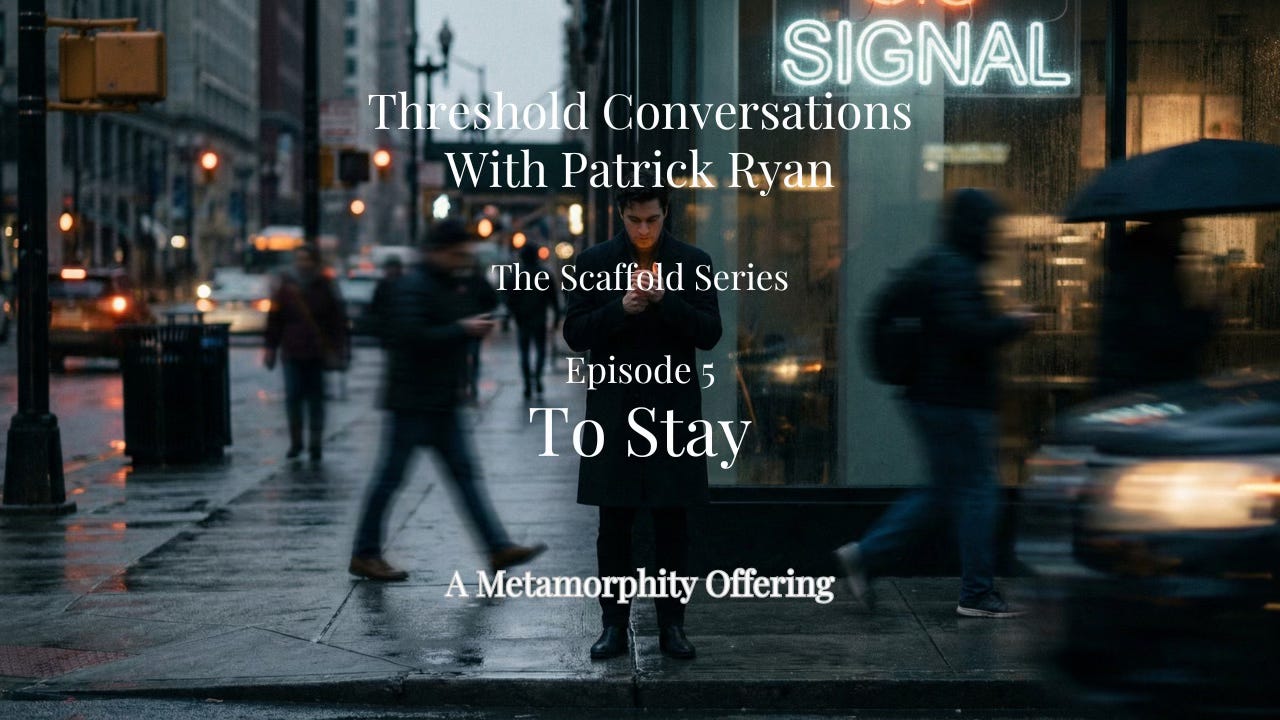
Listening has consequences.
After the signal is received—after that quiet, internal shift says this way or not this—there is a pause. A gap.
That pause is not comfortable. It’s the moment where awareness lands in the body and begins to rearrange the furniture. Insight becomes sensation. What you know starts to touch what you fear.
This is where most people turn back. They mistake the discomfort for a wrong turn. It isn’t. It’s the sound of the engine adjusting to a new grade.
⸻
Hearing the signal is hard enough. It requires slowing down, stepping off the constant motion of the Scaffold, and loosening the identities that kept you oriented. But once the signal is clear, the real work begins:
Can you stay present while it disrupts you?
The signal rarely offers a tidy “next step.” It offers a wrecking ball. It points toward grief you’ve been managing around, or a life that no longer fits the frame you built for it.
And the second that truth lands, the world rushes in to help you abandon it.
⸻
The systems we live in—the noise of the marketplace and the momentum of the “Jet Stream”—aren’t built for redirection. They are built for predictability. They want the machinery to keep humming.
Even the people who love you will resist your change. Not because they are unkind, but because your transformation unsettles the roles you play for them. Your listening exposes their avoidance. Your pause feels like a threat to a world addicted to acceleration.
The pressure returns instantly: Be practical. Don’t rock the boat. Why leave something that works?
Staying true to the signal in that environment isn’t just a choice. It’s a radical act of rebellion.
⸻
I remember when my life looked, from the outside, like a wonderful creation.
I had the business. I had the security of abundant momentum. I was surrounded by people who liked the version of me I had become. Everything made sense on paper—except something essential inside me had gone silent.
When I realized I didn’t want to keep going, the world urged me to stay on the rails. “Adjust,” they said. “Optimize.” But don’t leave. They were acting from care, but it was the logic of a world that values continuity over congruence.
But the signal had already spoken. Staying faithful to it meant standing alone in a room full of people telling me I was wrong. I didn’t have a plan. I didn’t have a destination. I only knew that if I stayed on that Scaffold, I was betraying the only thing that was real.
So I let go.
I didn’t do it for the drama. I did it because I was too tired to hold the mask up. I took my hands off the wheel and let the unknown have its way with me.
⸻
That choice reshaped everything. Some relationships endured; others fell away like dead weight. Entire chapters slammed shut.
Looking back, people call it courage or faith. In the moment, it felt like vertigo. It was simply the refusal to escape the discomfort until the truth was done with its work.
⸻
This episode isn’t a romantic call to take risks. It’s about the capacity to stay with what is being revealed—before you explain it, before you justify it, and before you “fix” it.
Staying with the uncertainty. Staying with the tremble of a life realigning.
This isn’t passivity. It isn’t “white-knuckling.” It is presence. And without it, you aren’t making choices—you are just reacting to the noise.
⸻
Any path that matters includes heat. There is no version of aliveness that avoids the friction of re-entry. You can stay small and protected, but the cost is a gradual estrangement from your own spirit.
To stay is to trust that you don’t need the whole map to take the next honest step. It is to remain available—not to certainty, but to life.
⸻
Field Notes: The Capacity to Stay
1. The Edge Pause When the static rises, the reflex is to act, fix, or leave. Interrupt that.
When you feel the surge—the tight chest, the urgency to decide—pause for 90 seconds. Don’t try to calm down. Don’t regulate. Just notice where the sensation is loudest. Does it shift if you don’t interfere? This teaches your nervous system that “feeling” is survivable.
2. Fear or Signal? Fear and signal both carry intensity, but their quality is different. Write it out:
If this is fear, what is it trying to protect?
If this is signal, what truth is it pointing toward?
Fear contracts and repeats. The signal steadies and clarifies—even when it’s asking for a sacrifice.
3. Staying Without Convincing The hardest part of staying is relational. We want to be understood.
In your next difficult conversation, try this: “I don’t have this fully figured out yet, but I’m staying with what feels true.”Then stop. Notice the impulse to justify or perform. Let it go. This builds the capacity to remain present without abandoning yourself to please the room.
⸻
In the final episode, we cross the threshold: Choice. Action that emerges not from habit, but from presence, courage, and aligning with integrity.
For now, look at the truth you are already receiving. What would it mean to stay with it just a while longer?


