

HI this is Patrick Ryan and these are Threshold Conversations on Metamorphity
We spend the first half of our lives obsessed with architecture.
We build structures. We build identities. We build businesses. We construct a “Scaffold” around our lives that allows us to climb higher, see further, and protect ourselves from the elements. We spend decades perfecting the blueprints—trying to understand why the walls are where they are, why the windows face a certain way, why the house feels cold or hot.
We become architects of our own psychology.
But every architect eventually runs into a problem that blueprints cannot solve. You can build the perfect house, but you cannot control the weather.
And eventually, a storm comes that blows the roof off.
That storm might be a failure. It might be a realization. Or, in my case this week, it might be the quiet, devastating absence of a beloved four legged creature who suddenly passed over.
And when the roof is gone, you realize that all your study of “architecture”—all your psychology, all your optimization, all your high-performance strategies—is useless against the rain.
At that moment, you don’t need a map. You need a floor.
Today, we are talking about the end of The Scaffold. We are talking about the transition from the architecture of the ego to the physics of Presence. And we are going to talk about what happens when life stops you in your tracks, and the only choice you have left is to Stay.
Part 1: The Limit of the Model
If you’ve been following my work recently, you know I’ve been deep in a series called “The Scaffold.” It was an investigation into the structures we build to survive. We mapped the “Jet Stream”—that addictive current of speed and validation that drives so many high-performers. We looked at the ego not as an enemy, but as a machine.
And that work is valid. It is necessary. You cannot dismantle a house until you understand how it was built.
But I recently hit a wall. Or rather, I hit the floor.
I realized that I could explain my own psychology perfectly. I could tell you exactly why I get impatient, why I have “unkind thoughts,” why I drive myself with such ferocity. I had the blueprints memorized.
But understanding the trap doesn’t unlock the door.
I found that I could have a perfect intellectual map of my own patterns and still be completely hijacked by a wave of irritation or anxiety five minutes later. The “Scaffold” was just decoration on a prison cell.
So, I am making a shift. I am burning the map.
We are moving from the study of “Self-Construction” to the practice of “Self-Subtraction.” We are pivoting from psychology—which is the study of the software—to physics—which is the study of the hardware. The nervous system. The spine. The field of energy.
Because when grief hits, or when the world breaks, you don’t need a better mindset. You need capacity. You need a nervous system that can conduct high-voltage sorrow without blowing a fuse.
Part 2: The Laboratory of Grief
I am speaking to you today from inside a laboratory.
It is not a sterile room with white coats. It is the silence of my own home, which has suddenly become deafening.
I recently lost my beloved cat.
Now, there are some who will hear that and think, “It’s just an animal.” And there are others—those of you who know the specific, aesthetic frequency of a cat—who know exactly what I am talking about.
For me, there is no distinction between the loss of a human and the loss of an animal. In fact, the grief for an animal is often sharper. It is cleaner.
Human relationships are messy. They are filled with words, negotiations, history, and the noise of the ego. But a relationship with a cat is pure signal. It is 100% presence, 0% performance. They are the totems of the very thing I have been trying to learn: how to simply be without needing to do.
Losing that presence is not just a sadness; it is an energetic event. The “pipe” of connection was wide open, and now it is cut. The silence that follows is heavy.
And this grief has become my teacher. It has done what years of meditation struggle to do. It has stopped me.
In the Sufi tradition, the mystic Al-Niffari speaks of a concept called Waqfa, or “The Standing.” He argues that we spend our lives “seeking” the Divine, climbing ladders, doing practices. But true realization is not a climb. It is a “Seizure.”
It is when Reality grabs you by the collar and stops you.
Grief is a Waqfa. It arrests you. It makes your “to-do” list look ridiculous. It burns the Scaffold. It forces you to stand still in the center of the pain because there is nowhere else to go.
And in that standing, I have had to apply the only tool that actually works. Entering Presence.
Part 3: The Movie and The Screen
We often talk about “observing our thoughts” or “being mindful,” but these terms have become watered down. We treat them like relaxation techniques.
The shift to Presence is not a relaxation technique. It is a survival mechanism.
Here is the physics of it: Imagine a movie theater. On the screen, there is a fire. The actors are screaming, the buildings are burning, the tragedy is unfolding. That is your life. That is your aging body. That is your grief. That is the “Scaffold.”
But the screen itself? The screen is not burning. The screen does not get hot. The screen does not age from the opening scene to the credits. It remains white, pristine, and untouched.
I have been watching this grief tear through my house. I feel the tears. I feel the ache in my chest. I feel the massive, heavy absence of my friend. That is the Movie. It is violent and real.
But I am also noticing something else. I am noticing that there is a part of me that is watching the grief, and that part is not grieving.
It is not cold. It is not dissociated. It is simply the Screen. It is holding the image of the pain with perfect clarity, but it is not damaged by it.
This is Presence.
If you try to fight the grief—if you try to “fix” it with your intellect—you will drown. That is trying to put out the fire on the screen by yelling at the movie.
But if you can shift your identity back—just one inch—into Presence, you find something incredible. You find Capacity. You realize that you are not the cup that is overflowing; you are the ocean that the cup was poured into. The dye is there, the color is deep red, but the ocean is not overwhelmed.
Part 4: Clean Pain vs. Distorted Pain
This week, in the silence of my house, I have been practicing the distinction between “Clean Pain” and “Distorted Pain.”
This is the technical work of Presence.
Clean Pain is the signal. It is the raw sensation of loss. It hits you in the chest. It is hot. It is heavy. It comes in waves—it peaks, it crashes, and it recedes. Clean pain is the price of love. It is the bill coming due for a connection that mattered. You don’t need to fix Clean Pain. You just need to survive it.
Distorted Pain is the narrative. It is the mind rushing in to explain, to judge, to resist. “It shouldn’t have happened like this.” “I can’t handle this silence.” “What if I never feel okay again?”
Presence sees the difference.
When I feel the Clean Pain, I let it burn. I turn toward it. I ask the observer questions: Where is it? Is it sharp? Is it heavy? I treat it like a high-energy phenomenon passing through my nervous system.
But when I hear the Distorted Pain—the story—I cut the feed. I step back. I realize that is just the “Scaffold” trying to rebuild itself. The ego hates a vacuum, so it tries to fill the silence with noise, even if that noise is suffering.
The practice—the only practice right now—is to refuse the noise and accept the burn.
Part 5: The Unsupported Spine
This brings me to the “Threshold.”
In my own life, I am feeling a call to move away from the comfortable, supported structures I’ve relied on.
In Kriya Yoga, there is a specific instruction for meditation: You must sit with an unsupported spine. You cannot lean back against the chair. You cannot rely on something outside of you to hold you up.
You have to find the internal alignment—the skeletal integrity—to hold yourself upright against gravity.
If you lean back, you fall asleep. If you use muscle, you get tired and angry. You have to find a balance that is pure physics.
Grief is forcing me into an unsupported spine.
The external support—the comfort of my little friend, the routine, the normalcy—is gone. I can’t lean on it anymore. I have to find the internal structure to stay upright in this silence.
This is not just about posture. It is about the soul.
We spend so much time looking for things to lean on—partners, careers, bank accounts, identities. We want the chair to have a back. We want to relax.
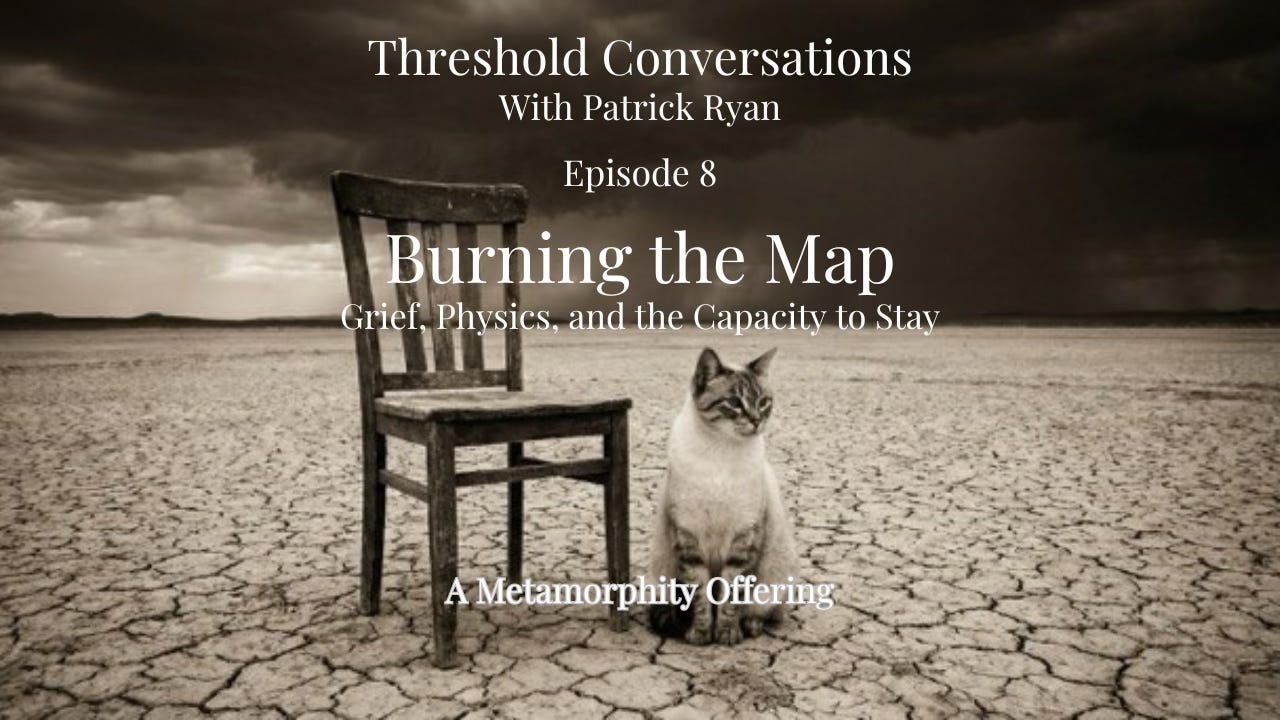
But the real work—the work of Presence—is learning to sit in the center of the void, with nothing behind you and nothing in front of you, and not collapse.
Part 6: The Edge of Capacity
So, where does this leave us?
It leaves us with a definition.
What is “Presence”? It is not just paying attention.
Presence is an aspect of the Universe itself. It is the Source looking through your eyes. It is the Observer witnessing the play.
But most importantly, Presence is the edge of the human capacity to occupy that space.
My book, Awakened Wisdom, talked about the “Eight States” of an Awakened life. I wrote that we cannot force enlightenment—we can only be “stricken” by it. We can only build the lightning rod and wait for the storm.
Well, the storm is here.
And my practice now is not to try to make the sun come out. My practice is to stand in the rain without closing my eyes.
If you are going through a transition—if you are burning a map, or mourning a loss, or feeling the “Scaffold” of your own life start to creak under the weight of change—I want to offer you this:
Do not try to rush to the next clarity. Do not try to “coach” yourself out of the discomfort. Do not try to build a new building yet.
Just Stay.
Stay with the Clean Pain. Stay with the silence. Stay with the sensation of the unsupported spine.
Shift your attention from the Movie to the Screen. Notice that while your heart is breaking, the Presence that watches the breaking is whole. It is ancient. It is the Universe meeting itself at the focal point of your life.
And once you realize you are that Presence, and not the person grieving, you don’t need the Scaffold anymore.
I’m Patrick. This is Threshold Conversations. Thank you for listening.


