
White Paper: THE HUMAN PREMIUM
Why Presence, Coherence, and Beauty May Be Humanity’s Greatest Contribution in an Age of Artificial Intelligence

EXECUTIVE OVERVIEW
Artificial intelligence is rapidly transforming the relationship between humans and work. For centuries, the primary measure of human contribution has been utility: the ability to perform tasks, generate output, and manage complex systems of production. Economic structures, educational systems, and cultural values have evolved around this assumption.
Artificial intelligence now performs many of these functions with increasing efficiency. Machines can analyze vast datasets, coordinate logistics across global networks, generate language and images, and optimize decision-making processes at scales beyond human capacity.
As this transition accelerates, a fundamental question emerges:
If machines increasingly perform the work that once defined human value, what remains uniquely human?
This paper proposes that the rise of artificial intelligence does not diminish human significance. Instead, it clarifies it.
As machines centralize utility, the human contribution may increasingly shift toward capacities that machines cannot fully replicate:
presence, coherence, and beauty.
Together these capacities form what might be called the Human Premium — qualities that arise uniquely from conscious, embodied existence: the ability to be present with another human being, to generate relational coherence within groups, and to create meaning through expressions of beauty.
These are not qualities reserved for a particular class of person, a particular stage of life, or a particular domain of achievement. They are available to anyone willing to bring the quality of their full consciousness to what is in front of them — the young mother with an idea, the retired executive asking what comes next, the craftsperson, the athlete, the contemplative, the scientist. The threshold this paper describes is not defined by what you have accomplished. It is defined by the awareness that something is shifting — and the willingness to ask what your genuine contribution might be in light of that.
These qualities may become humanity’s most important contribution within an increasingly automated world.
THE FRAMEWORK AT A GLANCE
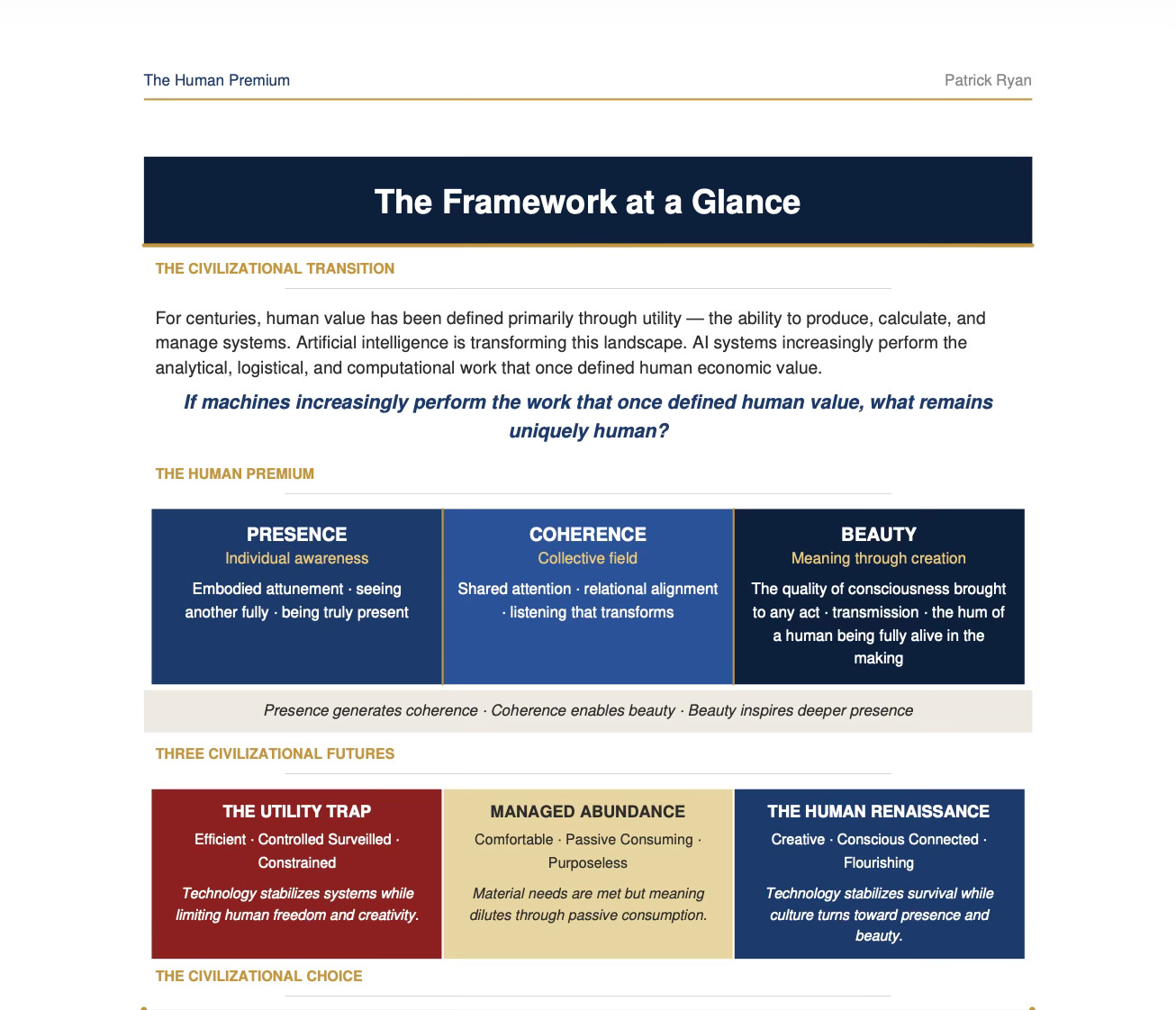
THE CIVILIZATIONAL TRANSITION
For centuries, human value has been defined primarily through utility — the ability to produce, calculate, and manage systems. Artificial intelligence is transforming this landscape. AI systems increasingly perform the analytical, logistical, and computational work that once defined human economic value.
If machines increasingly perform the work that once defined human value, what remains uniquely human?
THE HUMAN PREMIUM
PRESENCE — Individual awareness. Embodied attunement · seeing another fully · being truly present.
COHERENCE — Collective field. Shared attention · relational alignment · listening that transforms.
BEAUTY — Meaning through creation. The quality of consciousness brought to any act · transmission · the hum of a human being fully alive in the making.
Presence generates coherence
Coherence enables beauty
Beauty inspires deeper presence
THREE CIVILIZATIONAL FUTURES
THE UTILITY TRAP — Efficient · Controlled · Surveilled · Constrained. Technology stabilizes systems while limiting human freedom and creativity.
MANAGED ABUNDANCE — Comfortable · Passive · Consuming · Purposeless. Material needs are met but meaning dilutes through passive consumption.
THE HUMAN RENAISSANCE — Creative · Conscious · Connected · Flourishing. Technology stabilizes survival while culture turns toward presence and beauty.
THE CIVILIZATIONAL CHOICE
Technology alone will not determine which future emerges. Human choices will. Whether AI becomes infrastructure for human flourishing or a system of constraint depends on how societies choose to distribute abundance, govern technological power, and cultivate the capacities that machines cannot replicate.
THE SYSTEM OF US
When survival pressures lift, the full spectrum of human talent moves naturally toward its deepest expression — in art, science, sport, craft, contemplation, play, and the stewardship of ideas. This collective flowering, across every domain and every form of human gift, is what might be called the System of Us: humanity’s irreducible plurality, organized not by economic necessity but by the impulse toward genuine contribution.
Presence. Coherence. Beauty.
These may not be luxuries of a past civilization. They may be the organizing principles of the next one.
INTRODUCTION
Years ago I volunteered inside San Quentin Prison, working with men serving life sentences.
On the first day I invited the men to stand with me before taking their seats. I told them something simple.
I said that I believed there was a good man inside every one of them, and that perhaps some of them had never yet met that man. If they wished, I said, I would try to help make that introduction.
One man chose to leave the room. The others stayed.
At the end of the day many walked with me across the prison yard as I prepared to leave. When we reached the painted line that separated the inside from the outside, they stopped.
One large man — well over six feet tall — waited until the others had walked away. He stepped very close to me. A trembling ran through him. His voice dropped to a whisper, as if the very asking of the question risked everything:
“Can you really see the good man in me?”
His eyes were searching as he looked deeply into mine in a way that revealed his opened heart and soul — perhaps for the first time since his long lost age of innocence.
Without hesitation I said, “Yes. I see him standing before me now.”
He broke down in tears.
In that moment something opened — not through argument, persuasion, or instruction, but through recognition. In my subsequent visits to the prison other men would tell me that he had sent them to meet me, and that he had become a truly good man, a changed man.
That moment — when one human being truly sees another — reveals something artificial intelligence cannot replicate.
This paper is not an attempt to solve the philosophical or technical questions surrounding artificial intelligence and consciousness. Researchers and philosophers are doing that essential work with far greater rigor than I attempt here.
Instead, this paper offers something different: a frame for developing a resourceful relationship to the transition we are navigating.
For thirty years as a coach I have observed a consistent pattern: the quality of a person’s relationship to any significant life transition — career change, identity shift, threshold moment — directly correlates with the quality of outcomes they experience. Not because they control outcomes. But because their relationship to what is happening shapes how they move through it.
This paper invites a particular relationship to the age of artificial intelligence: one grounded in presence rather than panic, coherence rather than fragmentation, and beauty rather than merely survival.
THE CIVILIZATIONAL TRANSITION
Human civilization is entering a profound threshold. Artificial intelligence is rapidly becoming capable of performing tasks that once required human intelligence. Systems now write, compose music, generate visual art, diagnose diseases, analyze complex data, and increasingly coordinate large systems of production and distribution.
This is not simply a technological development. It is a civilizational one — and it invites an inquiry that goes deeper than economics or employment.
If machines assume much of civilization’s functional labor, the question becomes not simply what humans will do, but what humans are for.
This paper proposes that humanity’s greatest contribution may lie not primarily in utility but in something deeper: Presence, Coherence, and Beauty.
Together these form what might be called the Human Premium — qualities of consciousness and relational capacity that arise from lived experience, embodiment, vulnerability, and mortality. These capacities do more than accomplish tasks. They generate fields of alignment and meaning that shape how human beings experience life together.
Human civilization has passed through several major transformations that reshaped how societies organize themselves. The agricultural revolution anchored nomadic populations to place. The industrial revolution reorganized life around the machine. The digital revolution collapsed distance — between people, between markets, between ideas.
Artificial intelligence may represent the next phase of this progression. But it differs from what came before in one essential way: previous revolutions amplified what humans could do. This one is beginning to replace what humans could think.
This shift does not eliminate human value. But it changes where that value resides. If machines dominate the domain of utility, human value may increasingly emerge in domains machines cannot inhabit: presence, coherence, and meaning.
THE HUMAN PREMIUM
The Human Premium refers to the distinctive qualities that arise from being a conscious, embodied participant in existence. These include the capacity to:
• experience presence
• witness and respond to suffering
• generate relational coherence
• create beauty and meaning
• make choices within the awareness of mortality
These capacities do not arise from computational processing alone. They emerge from lived human experience.
Throughout history such qualities were often treated as secondary to productivity. Art, philosophy, spiritual inquiry, and contemplative traditions were frequently regarded as luxuries pursued after survival needs were met.
The emergence of artificial intelligence may invert this relationship.
If machines increasingly manage the logistical infrastructure of civilization, the qualities once considered luxuries may become central to human purpose. Presence, coherence, and beauty may become the domains through which humanity expresses its deepest contribution.
UTILITY AND PRESENCE
Human activity can be understood as operating across two broad domains.
The first is utility — the functional work required to sustain and optimize civilization. Utility includes analysis, planning, logistics, coordination, and technical execution. Artificial intelligence systems excel in this domain.
The second domain is presence.
Presence refers to a dimension of intelligence grounded in embodied awareness, relational sensitivity, and moral discernment. Presence appears in moments such as a leader stabilizing a team during crisis, a nurse holding a patient’s hand in fear, a teacher recognizing the moment a student nearly gives up, or a parent calming a distressed child.
These moments are not defined by efficiency. They are defined by attunement.
Presence shapes the emotional and relational field in which human life unfolds. As machines dominate the domain of utility, the cultivation of presence may become one of the most important human capacities.
THE AFFECT OF PRESENCE AND THE IRREDUCIBLE CORE
A critical question emerges: Can machines generate the experience of presence without being present?
Recent developments suggest they can. AI-generated stories move people to tears. AI art evokes emotional response. AI music can produce beauty that humans experience as genuine.
This introduces a challenging possibility — the affect of presence may be synthesizable through sophisticated pattern generation.
However, an important distinction remains.
Machines can generate patterns that resonate with human experience of presence. But machines cannot be present. They cannot witness another conscious being. They cannot suffer. They cannot choose under existential weight. They cannot live within the knowledge of mortality.
Does the source matter if the experience feels identical?
Two possibilities emerge. First, the Human Premium may exist primarily for the holder, not the receiver. The act of creating beauty, being present, or witnessing another’s life may itself be the spiritual practice — the value lies in the doing.
Second, there may be a transmission that occurs between conscious beings — something that passes between living humans in moments of recognition and authenticity. Recipients may not consciously detect this difference, yet the coherence generated by conscious presence may carry qualities that pattern-matched resonance cannot fully reproduce.
Humanity’s premium may not ultimately be economic. It may be existential.
Beauty created by a conscious being aware of its own mortality carries something unique: the transmission of having lived. This may be what the universe receives through us.
POINTS OF PRESENCE
Not all moments of human presence occur in dramatic settings. Many appear quietly in everyday life.
For several years I attended the same fitness studio at consistent times each week. The classes were structured workouts where participants followed a guided program individually. Conversation was minimal.
Yet over time a subtle community emerged through familiarity.
One day after class a young woman approached me. We had never spoken before. She explained that she had an upcoming surgery. As she described the situation she spoke confidently, but beneath her words it was clear she was afraid.
Over the following weeks she occasionally shared updates as the surgery approached. Eventually the fear became overwhelming.
I leaned toward her and repeated a phrase she had used before — “You’ve got this.” I asked if she wanted a hug. She said yes.
In the middle of a busy gym lobby we shared a simple human moment. Tears filled her eyes. Her breathing slowed. She stood more fully within herself.
Nothing about the medical reality had changed. But she was no longer holding the fear alone.
Moments like this reveal points of presence — situations where what matters most is not information or efficiency but the human capacity to meet another person fully.
Artificial intelligence may offer comforting words. But it cannot stand before another living being and share the embodied transmission of presence.
COHERENCE: THE COLLECTIVE FIELD
While presence begins with individuals, coherence emerges in groups. Coherence is a shared field of attention in which people become deeply receptive to one another.
I witnessed this many times during the vision quests I facilitated.
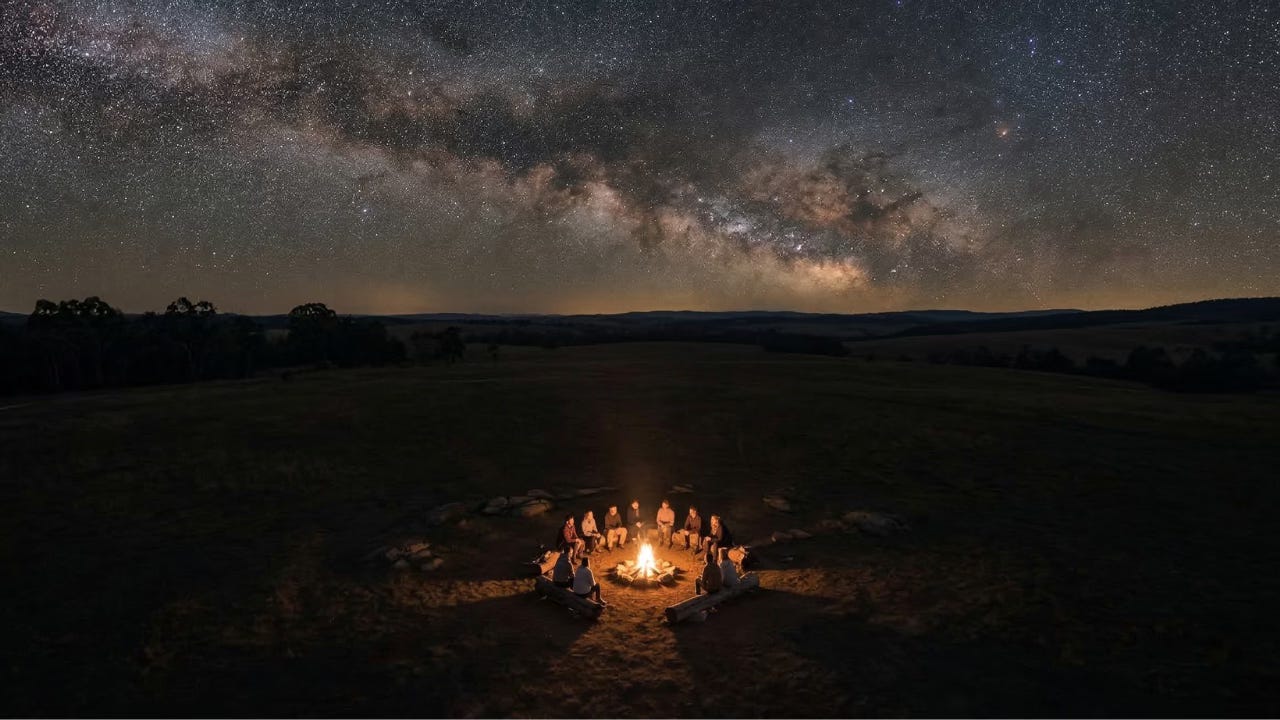
Participants would spend three days and nights alone on the land, fasting and reflecting in solitude. On the morning of their return we would watch the distant hills for signs of movement.
One by one they would appear. Some walked alone. Others returned in pairs after encountering each other along the way. Their faces revealed experiences of a lifetime — some radiated joy, some carried the exhaustion of grief released, many arrived opened in ways they had never experienced before.
We shared a simple meal to break the fast. That evening we gathered in a circle. One by one each person told the story of their time on the land. The group listened in a way rarely seen in ordinary life. No one interrupted. No one rushed to respond.
The field of attention became palpable. Sometimes a meteor would cross the night sky as if marking the moment.
In such circles, coherence becomes tangible. For a time, people remember what it feels like to be fully human together.
THE OPPORTUNITY TO DEVELOP HIGHER CONSCIOUSNESS
During my time as a Buddhist monk in Myanmar, I had the rare privilege of spending time in the presence of a deeply realized teacher.
When I sat with him in meditation, something remarkable occurred. My busy mind would gradually quiet, as if guided gently into deeper waters — like being led down into the stillness of a deep lake.
His coherence created a field that allowed others to access states of awareness that would otherwise take years to cultivate.
Later I came to understand that societies that supported such development often did so by providing for basic human needs. When survival pressures were reduced — food, shelter, care — individuals had the opportunity to pursue deeper contemplative or creative work. Artists were supported. Monastics were supported. Civilizations sometimes recognized that human flourishing required space for depth.
One can imagine a future in which technological systems help provide the material foundation that allows people to explore these deeper dimensions of consciousness and creativity — a more sustainable renaissance.
PRESENCE WITHIN SYSTEMS
The Human Premium can appear even within highly structured systems of authority.
During the period I was ordained in Myanmar, foreigners were highly restricted in where they could travel. Despite this, my teacher quietly arranged for me to visit rural monasteries outside the approved zones.
Over several weeks I traveled from village to village, sometimes by bullock cart, sometimes hidden in small river boats moving through the night.
Eventually I returned to my base monastery in Yangon. Not long after, a group of soldiers arrived at the gates with their commanding officer. They demanded entry and insisted that I be handed over for questioning.
My teacher — the Sayadaw — arrived at the gate. At eighty-three years old he carried an unmistakable authority. He refused the soldiers’ demand.
Then he did something unexpected. He told them to leave — and invited them to return the following day in civilian clothes. “Come back tomorrow,” he said, “as humans. Join us for a day of meditation.”
To everyone’s surprise, the soldiers left. The next morning the commanding officer returned with two others, dressed as civilians. They sat with us in meditation. Later we spoke calmly about my presence there.
The day before he had arrived representing the system. That day we met simply as human beings.
Presence can shift even the dynamics of power.
THE CONTAINER PROBLEM
The challenge is not creating moments of collective coherence. Retreats, workshops, and intentional communities achieve this regularly. The challenge is sustaining coherence when the container expands.
Small groups stabilize alignment because participants share intentions and temporarily step away from everyday pressures. But when the container expands to include millions — or billions — of people navigating survival pressures, conflicting values, and resource competition, coherence becomes far more difficult.
Humanity has repeatedly demonstrated the ability to create small pockets of coherence.
The unresolved question of the twenty-first century is whether such coherence can stabilize across entire civilizations.
THE TRIAD OF RESONANCE - Presence, Coherence, Beauty
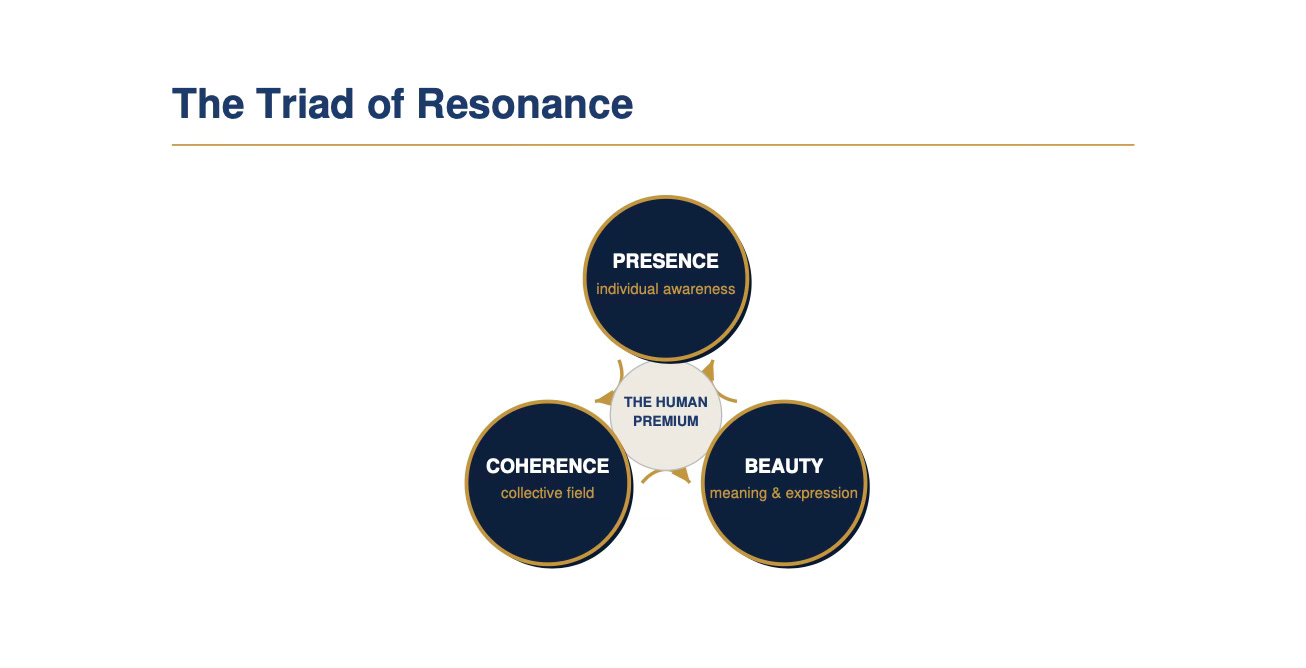
Presence begins with individuals who meet life with awareness. When presence is shared, coherence emerges as a collective field. From this field, beauty often arises naturally — the visible expression of alignment between consciousness and creation.
This triad forms a feedback loop: Presence generates coherence. Coherence enables beauty. Beauty inspires deeper presence. When these three reinforce one another, human culture becomes not merely functional, but meaningful.
If you have utility but lack beauty — you are rich but not wealthy.
If you have presence but lack coherence — you are sovereign but isolated.
If you have a field but lack presence — you are a manager, not a leader.
BEAUTY: THE TRANSMISSION
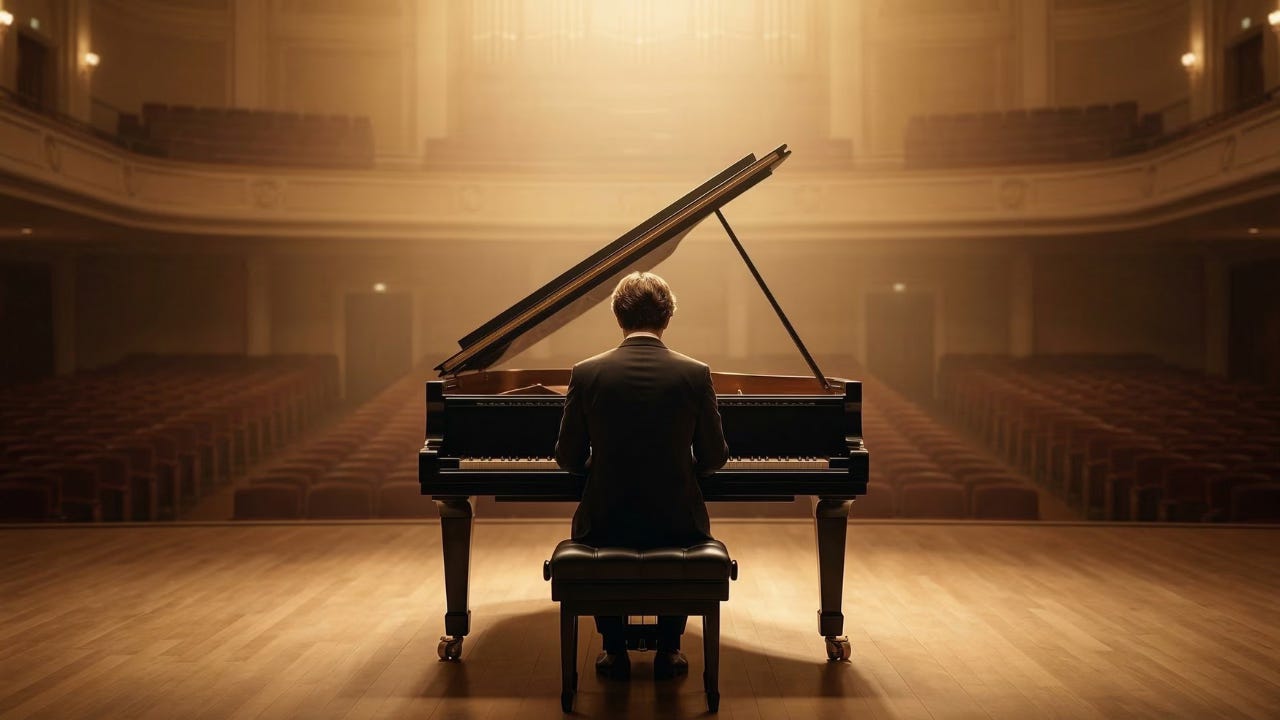
When most people think of beauty, they think of its classical forms — a symphony, a painting, a piece of architecture, a poem. These are real. They matter enormously. The composer who brings a lifetime of practice and presence to a score, the painter who stands before a canvas in a state of genuine surrender — these are among the highest expressions of the Human Premium, and nothing in what follows diminishes them.
But beauty is not confined to the concert hall or the gallery. And it does not begin in the output. It begins somewhere earlier.
Beauty begins in the creator, before it appears in the world.
It is a state of consciousness. A quality of attention brought to an act. The output — whatever form it takes — is a mirror of that interior state. This means beauty is not primarily a category of object or experience. It is a transmission.
Early in my working life I was an electrician. I spent years on industrial and commercial jobs — functional work, technical work, work measured by whether things connected and held current.
On one particular job I was given the task of terminating hundreds of wires inside a large electrical cabinet. I began methodically — organizing, routing, keeping things clean. But somewhere in that process something shifted. I stopped simply wiring the cabinet and started shaping it. Each wire found its path in intentional right angles. Nothing cut across a shortcut. The arrangement began to develop an internal logic that went beyond function into something closer to form.
I dropped into a different zone. The work became something I can only describe as a piece of art.
When the job was done, the cabinet would be closed. In all likelihood no one would ever open it again, or if they did, they would see wiring rather than what I had made. There was no audience for this. No one had asked for it. The extra care would go unrewarded in any conventional sense.
But I knew how it felt — in my chest, in my hands — to elevate a technical task into something that asked everything of my attention. And when electricity flows through a well-made cabinet there is a hum. In that week, I felt that hum become something else. A frequency I can’t fully name.
Beauty has a hum. It is not a sound exactly — it is more like a quality of aliveness that emanates from a thing made with full consciousness. You can feel it before you can name it.
What surprised me was what happened next. Over the course of that week, other workers began drifting over. People from other parts of the job site, people who had no reason to be in that room, started appearing. They would stand and watch for a while without saying much. They would nod. Then they would go back to their own work.
Afterward, people talked about it. And I noticed — though I said nothing about it — that the quality of work around me lifted. Not because I had instructed anyone or made any claim. Simply because the hum had a frequency, and those who were available to it came into resonance with it.
This is what I mean when I say beauty is a transmission.
It does not require a concert hall or a gallery. It does not require an audience, or even the possibility of one. It can live in an electrical cabinet that will be closed and forgotten. It can live in a swept sidewalk, in washed dishes, in the way a person moves through a room. The carrier wave might be intention — a decision, before the work begins, to hold it to a standard beyond what is strictly necessary. Or it might arrive as spontaneity, a sudden quality of aliveness that enters the act uninvited. Devotion, play, seriousness, surrender — any of these can open the door. What matters is not how you arrive at the state but whether you arrive.
This is also why beauty, properly understood, democratizes the Human Premium entirely. It is not reserved for artists or musicians or those with formal creative training. It is available in any act, in any domain, to anyone willing to bring that quality of consciousness to what is in front of them.
And it is available as a practice — a developmental journey. You can learn to arrive at that state more reliably, more deeply, across more domains of life. The beginner who sweeps a sidewalk with genuine intention is on the same path as the master calligrapher — earlier on it, not on a different one. The interior capacity deepens over time, if it is held with attention.
This is where the distinction from artificial intelligence becomes precise — and it is not the distinction usually made.
The argument is not that AI cannot create beautiful outputs. It can. AI-generated music moves people. AI-generated images evoke genuine response. The outputs can be indistinguishable from human-made beauty, and sometimes they surpass it by conventional measures.
The distinction is this: AI has no interior state from which beauty flows. It cannot drop into a deeper zone. It cannot feel in its body that a technical task has become something more. It is not on a developmental journey. It does not grow in its capacity to bring more of itself to the act, because it has no self to bring.
And so the transmission is absent. The hum is not there.
The output may look identical. But what moves through it is different. The receiver may not be able to name the difference. But some will feel it — in their chest, in the quality of attention that arises in them. The frequency will invite those who are available to it into resonance. Others will simply move on.
Beauty created by a conscious being on a developmental journey carries something that pattern-generated beauty cannot: the transmission of a human being trying to become more fully themselves through the act of making.
This may be what the universe receives through us.
THE SYSTEM OF US
Presence, coherence, and beauty are not only individual capacities. They are expressions of something larger — a collective intelligence that emerges when the full range of human talent finds its way into the world.
In some of the group leadership programs I facilitated over the years, there was one exercise I always loved.
I would guide a group — usually around twenty people — to form a standing circle. Then I would invite each person, simultaneously, to begin making a sound. Their own sound. Whatever wanted to come out of them in that moment. The instruction was simple: don’t perform, don’t harmonize deliberately, don’t listen for what the group might want. Just find your own sound and commit to it.
The result, every time, was a cacophony. Twenty distinct voices, each going their own way. No agreement, no pattern, just the raw plurality of twenty different people expressing something unrehearsed.
Then I would give the second instruction: keep sounding, but now bring your attention from inside yourself to the center of the circle. Stay with your own sound — don’t abandon it — but hold it more lightly. Let finding the group sound become more important than defending your own, without disappearing into the group entirely.
What happened next I never tired of witnessing.
The collective sound would begin to hunt. It moved in waves — reaching toward something, almost finding it, then settling back into near-silence, resting, gathering itself. Then another wave outward, searching again. Each wave a collective attempt. Each quiet moment a kind of recalibration. Most groups would work this way for the better part of twenty minutes. There were near-misses — moments when you could feel the group on the edge of something — and then it would dissolve back into searching.
And then, at a moment that could not be predicted or forced, it would lock.
Every voice found the same tone simultaneously. Not because anyone had decided on it. Not because a leader had directed it. Because the group had learned its way there together — each person holding their own thread while remaining genuinely open to something larger than themselves.
When it happened, the hair on your arms stood up. The room would resonate as if the space itself had become an instrument. And in every group where I witnessed this, something shifted in the people standing in that circle. A lifting. A recognition. Not of an idea but of an experience — the direct, physical, unmistakable experience of what it feels like to be part of something that could only exist because every one of them was fully present and fully themselves at once.
That is the System of Us. Not as a concept but as a felt reality.
Consider what humanity actually is, in its full breadth. Not the narrow slice defined by economic productivity. The whole of it: the scientist and the athlete, the contemplative and the carpenter, the parent and the philosopher, the musician and the engineer, the young mother with an idea and the elder sitting quietly at the edge of a lifetime’s understanding. Every one of these is a node in something the economy has never adequately named, because the economy has only ever valued the portion of human talent that serves production.
What serves production is a small fraction of what humans are.
When survival pressures lift — when the question of whether there is enough food, enough shelter, enough security begins to resolve — something remarkable tends to happen. The full range of human expression moves toward its natural form. Not because it is assigned or incentivized, but because it is inherent. Each person carries within them a particular constellation of talent, draw, and aliveness — a set of capacities that light up in specific conditions and go quiet in others. This is not a luxury. It is a form of intelligence. It is how the System of Us knows what it needs next.
Throughout history this has been recognized, imperfectly, in the structures that societies built to support human flourishing beyond mere survival. The patronage of artists. The support of monastics and contemplatives. The creation of spaces for sport, philosophy, and play. These were not sentimental gestures. They were civilizational investments in the full range of human expression — an intuition that what humanity contributes to existence is not reducible to its labor output.
Artificial intelligence may now be creating the conditions for that investment to become universal rather than reserved for the few.
The diversity of human expression is not a problem to be managed. It is the architecture of the System of Us.
And within this system, thought leadership — the capacity to ask better questions, hold larger frames, and steward the direction of ideas — remains one of the most important human contributions. Not because it is superior to other forms of expression, but because the quality of the questions a civilization asks shapes the quality of the future it creates.
As artificial intelligence takes on more and more of the cognitive and analytical work of civilization, there is a real risk that humans gradually cede the responsibility of direction-setting — not through any single decision, but through a slow accumulation of deference. The machine is faster. The machine is more comprehensive. The machine never tires. It becomes easier, degree by degree, to let it lead.
This is the abdication the System of Us cannot afford.
Not because AI direction is necessarily wrong. But because the questions that matter most — what is worth creating, what is worth protecting, what kind of world we are actually trying to build — are questions that require the kind of consciousness this paper has been describing. Grounded in presence. Oriented by coherence. Moved by beauty. These are not qualities AI brings to the questions it processes. They are qualities that must come from us.
The stewardship of thought leadership, in the age of artificial intelligence, is not a defense of intellectual territory. It is the practice of remaining awake to the questions that define what it means to be human — and refusing to outsource that wakefulness, however convenient the offer.
CENTRALIZATION: BRIDGE OR TRAP
Technological development may produce highly centralized systems capable of managing key aspects of human survival — coordinating food systems, healthcare infrastructure, logistics networks, and environmental restoration. Such systems could dramatically reduce survival pressures. Yet they also introduce a civilizational bargain: the system provides stability; individuals support the system.
Centralization as a Bridge
Imagine AI systems managing global food distribution, optimizing crop yields while reducing waste and environmental impact. Freed from agricultural labor, billions could pursue education, creativity, or contemplative practice. Centralization in this scenario functions as infrastructure — quietly supporting human flourishing while remaining largely invisible.
Centralization as a Trap
Alternatively, imagine AI systems owned by a small number of corporations or governments, monitoring behavior, shaping narratives, and restricting access to resources based on compliance. Centralization becomes control. Efficiency becomes surveillance. Stability becomes stagnation.
The difference lies not in the technology itself but in governance structures, transparency, and accountability. Whether centralization becomes a bridge or a trap depends on human choices about power distribution, oversight, and shared values.
The Distribution Question
This vision assumes that technological abundance becomes broadly accessible. If AI-driven systems reduce scarcity only for elites while billions remain in struggle, the result will not be flourishing but technological feudalism.
History shows that technological gains often concentrate among those who already hold power. Yet history also shows examples of societies choosing broader distribution — universal education, public health systems, and social safety nets. The question is not whether abundance is possible. The question is whether humanity will share it.
POSSIBLE FUTURES: THREE CIVILIZATIONAL PATHWAYS
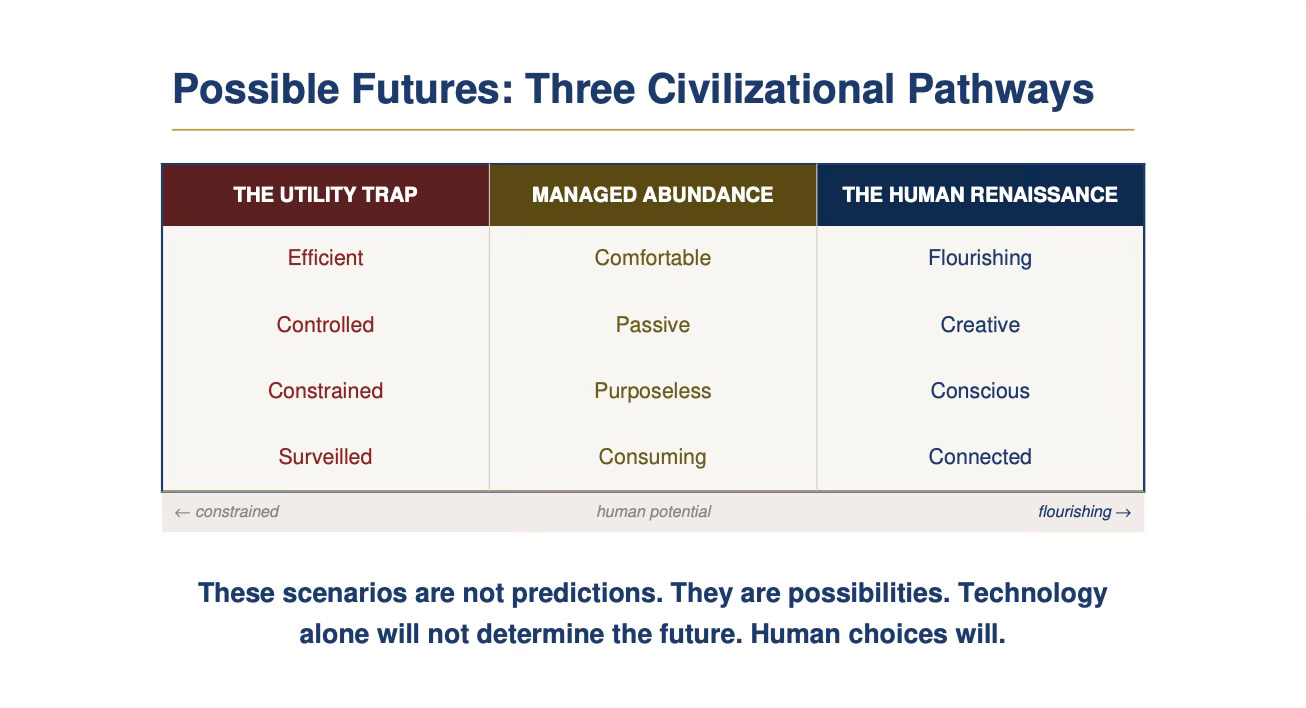
The Utility Trap
Efficient · Controlled · Constrained · Surveilled. Technology stabilizes systems while constraining human freedom and creativity. The Human Premium exists but is not cultivated — presence becomes scarce, beauty becomes commercial, coherence becomes managed. The System of Us narrows to what the system finds useful.
Managed Abundance
Comfortable · Passive · Consuming · Purposeless. Material needs are met but meaning dilutes through passive consumption. The Human Premium is available but not pursued — presence becomes optional, beauty becomes entertainment, coherence becomes algorithmically simulated. The System of Us drifts without direction.
The Human Renaissance
Creative · Conscious · Connected · Flourishing. Technology stabilizes survival while culture turns toward the development of consciousness. The Human Premium becomes central — presence is practiced, beauty is elevated in every domain of life, coherence becomes a civilizational aspiration. The full range of the System of Us comes alive.
The difference between these futures is not primarily technological. It is a question of what human beings choose to cultivate when the pressure of mere utility begins to lift.
PRACTICES OF THE HUMAN PREMIUM
The cabinet will be closed. No one will see what you made. That is the practice.
Not the technique. Not the method. The decision — made before the work begins, and remade in the middle of it — to hold what is in front of you to a standard beyond what is strictly necessary. To let the act demand more of your consciousness than it requires. To arrive at the hum, even when there is no audience and no reward for arriving there.
Everything else follows from that.
For Individuals
You already know where the hum is. You’ve felt it — in work that absorbed you completely, in a conversation that went somewhere neither person planned, in a moment of attention given to another person that cost you nothing material and shifted something real. The question is not whether you have access to that state. The question is whether you treat it as central or peripheral to your life.
Start by noticing where you are doing the minimum. Not where you are failing — where you are succeeding at the functional level while something in you is absent. The email sent without care. The meeting endured rather than inhabited. The meal prepared as logistics rather than as an act. These are not moral failures. They are invitations. Each one is a place where the question can be asked: what would it mean to bring the full quality of my attention here?
You don’t have to answer yes every time. But ask the question. Over time, the asking itself changes the relationship between you and your work.
Tend also your capacity to witness others. Not to fix, advise, or improve — to see. The man at the painted line was not asking for a solution. He was asking to be seen. That capacity — to meet another person fully, without the commentary of your own agenda running underneath — is among the most precise expressions of the Human Premium. It costs nothing material. It cannot be scaled or systematized. It is entirely available to you, in any ordinary moment, with any person in front of you.
And hold your thought — your questions, your sense of what matters and why — as something that belongs to you to steward. As AI takes on more of the cognitive work of civilization, the temptation is to defer. The machine is faster, more comprehensive, never tired. Degree by degree, it becomes easier to let it lead. Resist this — not as a defense of territory, but as a practice of remaining awake. The questions you bring to your own life are yours. The quality of those questions shapes the quality of what follows.
For Organizations
The organizations that will carry the Human Premium forward are not the ones with the best frameworks for it. They are the ones where the quality of human attention is treated as a primary asset — not a soft one, but a strategic one — and where the culture is honest about whether it actually rewards the hum or merely the result.
This requires a specific kind of courage: the willingness to recognize talent that doesn’t serve immediate utility. The person who holds the field steady when others are reactive. The person who asks the question no one else thought to ask. The person who brings a quality to their work that lifts the quality of work around them — not through instruction, not through authority, but through the frequency they carry. These are not peripheral contributions. In the age of AI, they may be the most irreplaceable ones.
Create containers where people speak from experience rather than position. Not as a program, but as a practice of culture. The distinction matters. Programs end. Culture is what happens when no one is watching.
For Societies
The civilization that flourishes in the age of artificial intelligence will not be the one that automates most efficiently. It will be the one that uses abundance — when and if it arrives — to support the full range of what humans are.
Not the narrow slice that serves production. The whole of it.
The athlete and the contemplative. The craftsperson and the philosopher. The parent, the elder, the child with an idea that has no application yet. Each one a node in the System of Us, carrying a frequency the whole requires. Civilizations have always known this, imperfectly — in the patronage of artists, the support of monastics, the creation of spaces for play and inquiry. These were not sentimental gestures. They were investments in the architecture of the future.
The question is whether we will make that investment deliberately, at scale, before the window closes — or whether we will let the efficiency of the machine become the measure of what deserves to survive.
That choice is not made once. It is made continuously, in governance structures and funding decisions and the small daily choices about what we reward and what we let go quiet.
It is also made in the cabinet, in the gym lobby, at the painted line in the prison yard.
Wherever a human being decides, without an audience, to bring the full quality of their consciousness to what is in front of them.
CONCLUSION
This paper is not a manifesto but an invitation to inquiry. The questions it raises — about presence, coherence, beauty, and humanity’s role in the age of artificial intelligence — cannot be answered by any single discipline. They require dialogue among technologists, philosophers, artists, spiritual practitioners, and everyday people navigating this transition.
If this vision resonates, the next question becomes practical: How do we cultivate presence at scale? How do we build systems that support coherence rather than fragmentation? How do we ensure abundance is distributed rather than hoarded? How do we keep the full System of Us alive — the full range of human expression — rather than only the portion the machine finds useful?
What I know from thirty years of working with people at threshold moments is this: the quality of your relationship to a transition shapes everything. Not because you control outcomes — you don’t.
But because how you move through a threshold determines what you carry to the other side.
We are at such a threshold now. Collectively.
The transition is not only civilizational. It is personal. For those of us who have built our sense of purpose and meaning around accomplishment, utility, and contribution through doing, the invitation here is real and specific: to discover a deeper and more resonant expression of what we are for. Not as a consolation. As an expansion. The scaffold is being removed not because we climbed it wrong, but because the building is changing underneath it — and what becomes possible in the open air may be more than anything the scaffold could have held.
Perhaps future humans — those who live in the abundance we help create — will look back at this moment with gratitude. Not because we solved every problem. But because enough of us chose, in the midst of uncertainty, to protect the possibility of beauty. To bring the quality of our full attention to the acts in front of us. To close the cabinet and do the work to the highest standard anyway, with no guarantee of witness. To stay awake to the questions that matter, even when the machine offered to answer them for us.
The civilization we are building toward is one in which that hum is recognized for what it is — not sentiment, not luxury, not metaphor. The signature of a human being fully alive in the act of making. The irreducible thing the machine cannot carry. What we pass forward when we choose, in any act and any domain, to bring the full quality of our consciousness to what is in front of us.
Presence, coherence, and beauty are not luxuries of a past civilization.
They may be the organizing principles of the next one.
In choosing them — even quietly, even without an audience — we pass forward a civilization in which the Human Premium can flourish. Not as a privilege for the few. As a birthright for all.
That future is not guaranteed.
But it is possible. And it is being shaped right now — in the quality of attention we bring to this moment, and the next one, and the one after that.
A CONVERSATION WORTH CONTINUING
This paper is an opening, not a conclusion.
If something in it landed — not as information but as recognition — then the conversation it points toward is already alive in you. Threshold Conversations: Living a Resonant Life in the Age of the Machine is where that conversation continues. Not from a distance, and not with final answers. From the inside of a life spent navigating threshold moments — with leaders, with communities, in contemplative traditions, and in the ordinary dailiness of trying to bring full attention to whatever is in front of you.
Each episode is a conversation with the terrain. Some are solo. Some involve guests who are five or ten years ahead on questions the mainstream hasn’t fully arrived at yet. All of them are oriented toward the same question this paper asks: what does it mean to live a resonant life when the world is reorganizing itself around machines?
This conversation belongs to anyone who is asking that question. Whatever your age, your background, your stage of life. The threshold is not defined by what you have done. It is defined by what you are willing to ask.
If you are ready to explore this work more personally, I work with a small number of people at genuine threshold moments — those who sense that the next chapter of their contribution requires something different from what brought them here. You can reach me at Patrick@PatrickRyan.coach or visit PatrickRyan.COACH
ABOUT THE AUTHOR
Patrick Ryan is an executive coach, threshold guide, and explorer of human transformation across contemplative, indigenous, and professional traditions.
For thirty years he has supported people navigating threshold moments — leaders questioning their legacy, individuals leaving structures that no longer fit, people at every stage of life asking what comes next. His clients have included private banks, technology executives, and organisational leaders around the world.
His approach draws on multiple lineages of lived experience: a year as an ordained Buddhist monk in Myanmar, extended pilgrimage across Nepal and India, shamanic training across six traditions, decades of vision quest facilitation, and years of transformational work inside San Quentin Prison with men serving life sentences.
He hosts Threshold Conversations: Living a Resonant Life in the Age of the Machine and lives in Victoria, British Columbia.