
Rewriting the Human Contract
The Scaffold and The Ground

This week, I was walking around the downtown area of my city, running errands and picking up items I needed. Suddenly, it hit me: every single person I engaged with at these large and small businesses was performing a function that will someday soon be done by AI.
I imagined what the walk would be like with robotic dispensers that can make coffee and speak a dozen languages, or retail stores with rows of goods monitored by cameras and the cameras monitored by AI security bots. I felt the loneliness of that walk. When humans are no longer needed to do the tasks, we lose the humanity in the process.
I felt myself grieving in advance of this future.
Most of us will have some version of that moment as the jobs are cut back and the machines roll in. It is the quiet recognition that the small contract we had with the world is being broken.
The Old Contract: “I do this thing with my mind or my body, and in exchange, I am allowed to eat, have a place to sleep, and possess some dignity.”
That contract is being rewritten without our signature.
The elevators used to have human operators; then they didn’t. The switchboard required hundreds of thousands of women with fast fingers and soft voices; then it didn’t. Now, it is the bodies themselves that are becoming optional. The disruption is no longer coming for the coders and the copywriters first. It’s coming for all of us at once.
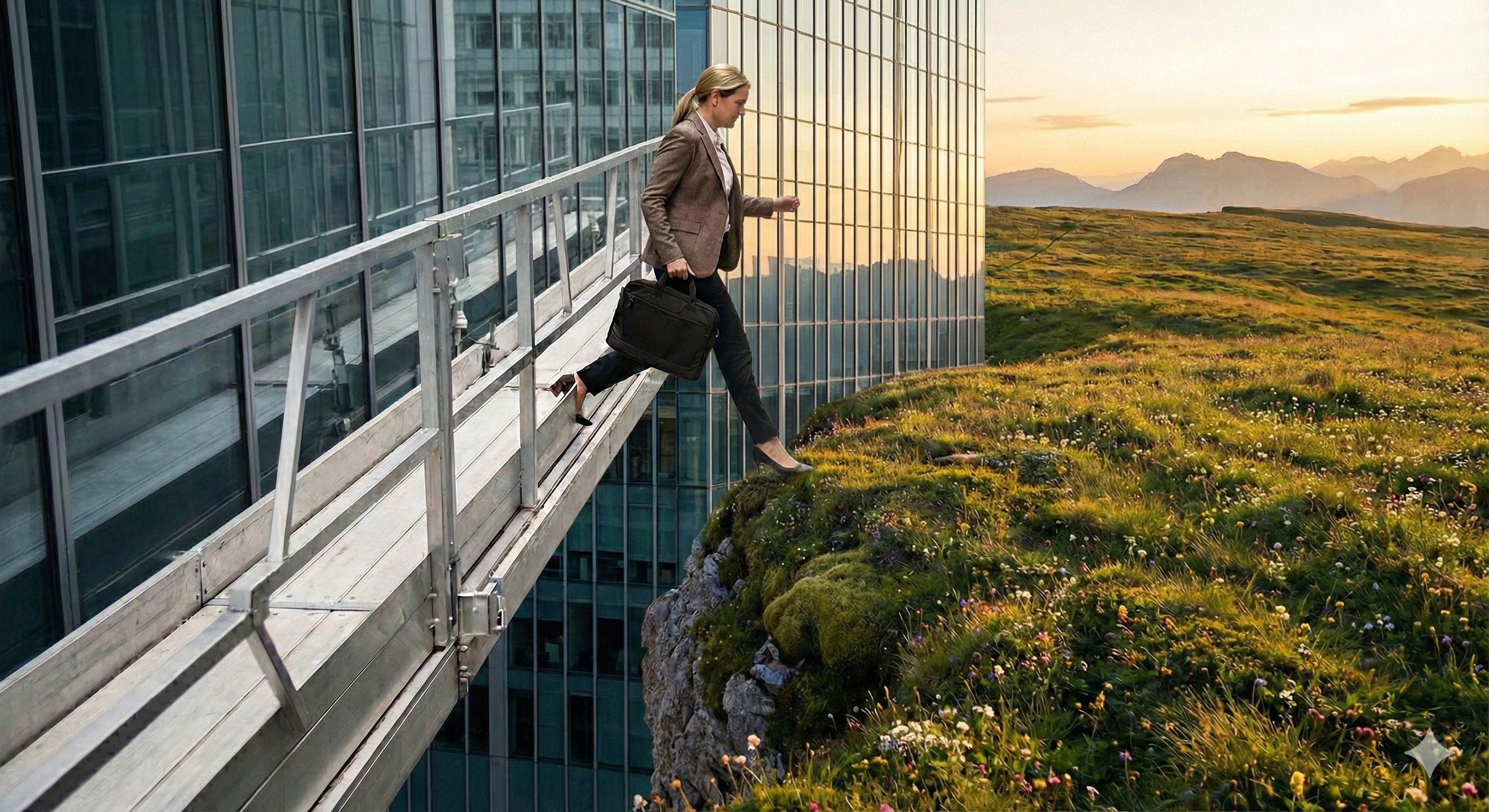
We are witnessing the removal of the scaffold.
I want to be clear here. I whole heartedly believe that We will adapt to this disruption as we always have before. There will be more fulfilling jobs and ways to live a life of meaning and purpose. And the transition will be bumpy.
Living on the Scaffold
For generations, we have been living on a scaffold, mistaking it for the solid ground.
The scaffold is the external structure of “doing.” It is built from our roles, our titles, our economic utility, and the visible labor that pays the rent. It was meant to be a temporary structure to help us build a life, but somewhere along the way, we moved onto the planks. We set up house on the temporary supports. We convinced ourselves that the higher we climbed on this rickety structure, the more we were worth.
The scaffold is made of the illusion that our output is our identity.
Now, that scaffold is not only being revealed as the illusion it always was, but it is being dismantled from the bottom up.
The Return to Ground
The removal of the scaffold is frightening, yes. But it is also an invitation.
When the artificial height is removed, we are returned to the ground.
The ground is the layer of true meaning. It is the “being” rather than the “doing.” It is the intrinsic worth that exists simply because you are here, not because of what you produced today.
Falling onto the ground of true meaning won’t be easy—our egos are bruised when they lose their altitude—but the ground is where the reality is. The scaffold was always shaky. The ground is solid. It is the only place where we can actually build something that lasts.
So, how do we prepare for this descent? How do we align with a new paradigm where “who you are” matters more than “what you do”?
Here are three places to start:
1. Invest in the Un-Automatable The machine can process data, predict patterns, and execute tasks faster than you ever will. Do not compete there. Instead, double down on what cannot be coded: empathy, deep listening, and genuine presence. When you interact with a cashier, a colleague, or a neighbor, do not just transact. Connect. The “efficiency” of the interaction is for the robots; the resonance of the interaction is for us.
2. Separate Your “Self” from Your “Function” Start practicing a new way of identifying yourself. When someone asks, “What do you do?”, notice the impulse to offer your job title as the entirety of your answer. Try to mentally decouple your soul from your salary. You are not the scaffold you stand on. You are the awareness that observes it. The more you practice this separation now, the less painful it will be when the external role shifts or fades.
3. Befriend the Silence On the scaffold, we are constantly moving, climbing, and fixing. On the ground, there is stillness. Many of us are terrified of silence because it feels like “unproductivity.” But in the new paradigm, your ability to sit in stillness, to reflect, and to access wisdom from the “Originless” will be your greatest asset. Start small. Take ten minutes a day to do nothing—no phone, no output, no “doing.” Just be.
The Invitation
The disruption is coming, in fact it is here. The scaffold is shaking. But we do not need to fear the landing.
We have the opportunity to stop clinging to a structure that never really supported us anyway. We have the chance to plant our feet on the earth of our true purpose—not as human doings, but finally, fully, as human beings.
The ground is waiting. It is good to be home.
A Note from Patrick If you are looking for support in navigating this shift from the scaffold to the ground, I have curated a series of guided meditations on Metamorphity.com designed to help you find your footing